

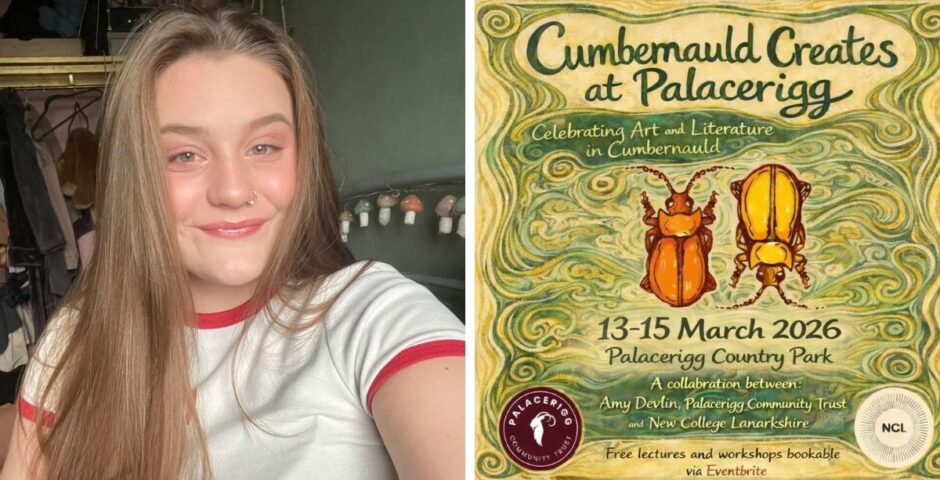
Meet Amy Devlin: The student building community for young Scottish working-class artists
An ode to the underdog

Earlier this month, I sat down with fourth-year Glasgow Uni student Amy Devlin to learn more about her exhibition at Palacerigg Visitor Centre in Cumbernauld.
Running from Friday 13th March to Sunday 15th March, the exhibition brought together Amy’s own poetry with the artwork created by students from local schools and colleges. This resulted in a collaboration showcasing community, creativity, and working-class voices.
A project rooted in place

Amy has lived in Cumbernauld all her life, which made Palacerigg the obvious choice. The location also ties into the themes of the exhibition – an area for the local community to explore nature within an industrial heartland.
The idea for the exhibition was, in total, a year in the making and grew out of one poem. Amy’s piece My Semicolon is an Abandoned Nature Reserve gained attention after she was interviewed by Len Pennie (one of her artistic inspirations) on BBC Radio Scotland. She wrote it after spending three hours walking through Palacerigg attempting what she jokingly calls a “hippy dippy” poetry ritual.
Despite her doubts, something stuck. The ritual brought out what she describes as “icky nostalgia” which is a running theme through her work and those featured in the exhibition. This “icky nostalgia” captures the uncomfortable tensions between memories, loss, and the necessity for humans to step-back to let nature reclaim space. The semicolon motif runs throughout as a symbol of continuation where there could have been an end. “It’s more a hindsight nostalgia,” she explains. “The one where your rose-coloured glasses have been taken off.”
Opening the door to young artists

Rather let momentum fade, Amy decided to keep the ball rolling and even see if it would be possible to get other local young people involved. She described to me how she approached New College Lanarkshire with the idea of getting a few students to volunteer to create some artwork inspired by her poem. What followed surprised her.
Not only did students volunteer, but the college incorporated the project into its curriculum. Young pupils in schools across the local area got involved too – Amy speaks fondly of one S1 student who contributed a haiku.
The participants were given complete creative freedom, but Amy was struck by how closely their work seemed to align with her own themes. “They really understood the assignment,” she says when highlighting how themes of nature, feminism, and ecology all feature throughout the exhibition.
Amy points to the united Scottish Gen Z experience as a possible explanation for these common threads. Although a global issue, climate anxiety is particularly pertinent for Scottish youth. Amy points out that beautiful natural spaces seem to be constantly under threat, citing the now-scrapped plans for Flamingo Land development at Loch Lomond as an example.
‘A win for the underdogs’


But the exhibition isn’t just about loss. It’s also about community and was built almost entirely through sheer goodwill. Amy reached out to a wide range of people from across her community, many of whom offered their time and skills free of charge.
It is something she is keen to express her gratitude for but also is acutely aware of how it highlights a wider issue. For working-class artists, opportunities often come with additional barriers: lack of funding, fewer connections, limited access to green and creative spaces.
“This is a win for the underdogs,” Amy says. Her project shows what’s possible without traditional resources, but also why proper support matters if work like this is to continue long-term.
Finding a voice beyond trauma

Poetry, for her, provides both mental and physical relief. Amy’s work often draws on personal experience, including difficult moments in her life. She talks about the “vibrations” of speaking it aloud as a therapeutic practice. But she’s also learning to separate herself from that and develop a voice that isn’t solely defined by trauma.
I was inspired by Amy’s outlook to her creative process, describing the necessity of both seizing the moment when something comes to you but also the importance of letting things sit for a while. When asked how she deals with challenges, Amy (a natural poet) used a metaphor of “fried ice cream” to describe how she handles them to me. “People sometimes make the mistake of trying to cook it in a tiny pot, but you need to give it space to expand,” she explains.
What comes next

Amy is already full of passion for what comes next. She hopes to expand the project into other creative avenues, such as theatre and music, to help build a broader platform for working-class artists both within and beyond Cumbernauld.
Funding is the real challenge. While this exhibition succeeded through community support, sustaining projects like this will require long-term financial support.
The message from Amy remains optimistic. She wills people to leave her exhibition with the clear idea of knowing “making change like this is so possible.”
In a time of growing uncertainty for the arts, Amy’s work is grounded in hand-made efforts that AI generated-content just can’t replace. “People making art is something community can’t live without,” she says. Her work is certainly championing that message for the next generation of working-class artists in Scotland.
For more of the latest news, guides, gossip and memes, follow The Glasgow Tab on Instagram, TikTok, and Facebook.

Latest
First week back at uni? Here’s everything you need to pack in your bag

Mary Poppins is quaking in her boots…
London university releases statement after professor sentenced for a child sexual offence

Barry Langford was a Professor of Film Studies at Royal Holloway

Young father-of-two died on day he was due to start at University of Glasgow

Young father tragically passes away at 24 years old after suffering a brain aneurysm
Bella Ramsey’s specific acting career gives them ‘an edge’ on Celebrity Traitors (they hope)
Their past roles have prepped them for Missions
12 of The Celebrity Traitors season two cast asked to be Traitors, and six to be Faithfuls
Three celebs couldn’t make up their minds

Maya Jama’s game plan for Celebrity Traitors is to avoid trying ‘too hard’ or ‘overthinking’
This is really devious tbh
Newcastle University buildings evacuated after ‘suspicious item’ found on campus

Police, fire crews, and fire engines arrived at the scene
12 things every Fresher gets wrong in their first few weeks at uni

From wearing your lanyard everywhere to leaving your washing-up until it grows its own ecosystem
Our Celebrity Traitors predictions include Maya Jama turning on her fellow Traitors

Here’s what we think will happen

I’ve just realised that three cast members from Celebrity Traitors were in Game of Thrones

Having flashbacks to Bella Ramsey being crushed by a giant


23 to 70: The ages of the Celebrity Traitors 2026 cast, from youngest to oldest

There’s a huge age range this year

James Blunt was a British Army captain before becoming a singer and joining Celebrity Traitors
He mentioned it on the show
Monster director finally admits why they forced Aileen Wuornos in a show about Lizzie Borden
Despite the name, Lizzie Borden is not the focus of the story
Shows and films you can watch about Aileen Wuornos, where she isn’t thrown into another story

Others tell her entire case, unlike Monster on Netflix

This viral tool lets you customise your Apple Pay cards, and here’s how to do it
You can personalise the entire design

James Acaster could be the Celebrity Traitors’ recruit, as filming reportedly paused for him
It’s not much of a cliffhanger

The ridiculous fortunes of The Celebrity Traitors: Their net worths, from £500K to £50 million
One of them could legit buy the castle three times over