
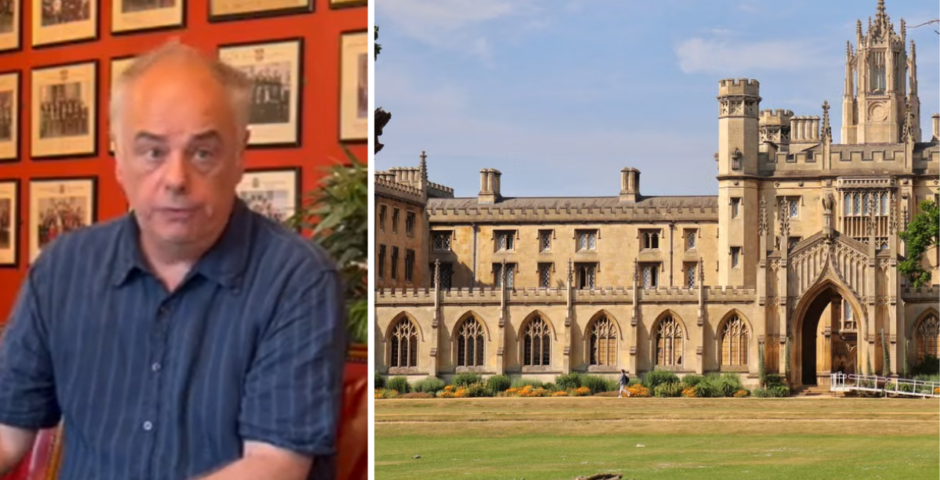
Cambridge professor wins tribunal after exposing alleged staff bullying
Wyn Evans, a professor of astrophysics, told the tribunal in June that he had witnessed a ‘bad history of misogyny’ within the Institute of Astronomy

A professor at the University of Cambridge has won an employment tribunal against his employer after alleging misogynistic bullying against female staff within the university’s Institute of Astronomy.
Wyn Evans, a professor of astrophysics, told the tribunal in June that he had witnessed a “bad history of misogyny” within the Institute of Astronomy.
He highlighted multiple examples of the alleged mistreatment of female employees, claiming that one woman had been “hounded out of a job,” another had been left “a frightened woman,” and a third had encountered “aggressive professors” in the department.
Wyn Evans also gave emotional testimony regarding the suicide of a female colleague, which he linked to the institute’s “terrible record of support” for female staff members.
During the tribunal, it was revealed that in July 2021, Evans had raised concerns via email that a female employee in the department was in a “fragile state of mind” due to what he referred to as a “personal vendetta” of Professor Richard McMahon, the then head of department, against her. Evans claimed that this had led to the woman fearing she would be made redundant, causing significant distress.
Following these allegations, Professor McMahon accused Wyn of wrongdoing. Rather than his concerns being taken seriously, Wyn was subsequently subjected to a two-year investigation by the university. The tribunal found that this occurred despite the allegations against him containing “scant particularisation, and no evidence to support them”.
Due to this, judges ruled that the grievances were made in retaliation against him and were therefore “likely malicious and vexatious”. The tribunal found a clear pattern of the university trying to shut down complaints made by Wyn in a bid to protect itself from reputational damage.
The tribunal also criticised processes within the university, particularly the tendency of senior figures to rely on HR and administrative staff to make decisions and prepare correspondence on their behalf.
For example, despite Vice-Chancellor Deborah Prentice claiming that she had drafted the response to Evans with assistance from university registrary Emma Rampton, it was found that Rampton had in fact written the entire response. The tribunal added that Prentice had “very little to do with it, save for putting her name on it.”
In another instance, a response rejecting Wyn’s complaints was drafted by the person that the complaint was about.
Ultimately, 11 of the 14 complaints made by Wyn against the university and senior figures within it, including the Vice-Chancellor, were upheld.
Judges unanimously ruled that he had suffered detriments for making protected disclosures, which is in breach of the Employment Rights Act 1996. They also found that the disclosures made by Evans were in the public interest.
Following the ruling, Wyn Evans spoke out to question Prentice’s fitness for office, saying: “Cambridge University has lost the whistleblowing tribunal, with vice-chancellor Deborah Prentice among the respondents found to have retaliated against a whistleblower. That comes on top of serious concerns about her leadership during the Jason Arday crisis. Taken together, these events raise a fundamental question: is Deborah Prentice actually in control of the university she is supposed to lead?”
In a statement, the university said: “We acknowledge the employment tribunal’s judgment of 10 August 2026 and are carefully reviewing it. We will now take time to reflect on the findings in detail.”
Damages in the case are due to be decided at a remedy hearing in January next year. These will include the amount of compensation that Evans is owed.
Latest
A closer look at John’s job, since he was stressing over it on Love Is Blind season 11

Sarah did not like him shouting down the phone

How Netflix production changed the real life story for New Stanford Prison Experiment reality show

Robocams were in the prison filming the cast
Three compelling clues Michaella and Rob broke up after Love Is Blind season 11
Exhibit B: Michaella’s Substack

Love Is Blind’s Aneha and Cam break down what they actually like about each other
‘He just looked completely different from what I was thinking’
A Love Is Blind participant who quit early found love with someone from the pods afterwards
Sahar and Tucker are still together now

What the Love Is Blind season 11 cast really do in their day jobs, as per their LinkedIns
It’s not hard to guess who has LinkedIn premium

The way Celebrity Traitors’ Jerry Hall decided to go all in on modelling is bizarrely iconic

Only Jerry Hall could make a painful moment a lifelong career
Traitors’ Sebastian Croft seemingly addresses secret relationship with co-star in new music
Following in Taylor Swift’s footsteps, the breakup pushed him to release his music
The huge cash payout Jerry Hall reportedly got in settlement when she divorced her billionaire ex
She also got a number of properties
Sense and Sensibility characters as different types of Newcastle students

Stay wary of any incarnation of a rugger
Lancaster University political societies release statement following alleged physical assault

The victim was reportedly taken to hospital with a shoulder dislocation
Rugby boys, soggy Greggs, and social martyrs: Things scarier than Halloween in the Toon

The looksmaxxers are probably dressed as Patrick Bateman
A message to the Leeds freshers finding university life hard

Uni is said to be the best years of your life, but it doesn’t always feel that way
Tired of the vampire fangs? Here are 10 new Halloween costume ideas for Cardiff students

Let’s actually be creative for once

Hannah Fry’s Celebrity Traitors spreadsheet updated to reveal who looks most suspicious

It shows which Faithfuls are safest

Top Selly Oak food spots for Birmingham uni students to visit while hungover

Here are the top spots to eat for those days when cooking is the last thing on your mind, and your hangover needs an instant cure
Sorry TikTok: Celebrity Traitors’ James Acaster has a secret girlfriend, and they have four cats
You know its serious when felines are involved
Halloween without the hangover: A guide to sober Halloween in Bristol

Not a fan of sticky dance floors and overpriced drinks? Bristol has plenty of ways to celebrate Halloween without stepping foot in a club.

Let Liverpool cure your autumn blues this October

5pm finishes might leave you feeling gloomy this semester, but Liverpool has everything students need to make the most of this autumn season
King Kenny sparks Celebrity Traitors winner theories after revealing alliance is ‘unstoppable’
He seemed very confident