

Glasgow Uni scientists to pioneer groundbreaking 3D heart images
The uni have been granted £4m to fund the project

University of Glasgow researchers are set to start a major new research project which aims to create the world’s most detailed 3D images of the mechanical forces at work inside a living, beating heart.
Receiving £4M in funding from the global charitable foundation, Wellcome Trust, the university is partnering with researchers from Imperial College London and the University of Sheffield to embark on this seven year long project.
The project initially started with an 18 month study, which provided the first proof on the plausibility of turning this challenging idea into reality. The research involves developing sophisticated imaging techniques to directly measure forces inside the hearts of live zebrafish. These techniques are expected to provide insights into the physical forces that shape the heart in both health and disease; furthering cardiovascular research and creating valuable resources for further studies.
The team is studying genetically engineered zebrafish, a common model used for heart research. They have modified key proteins that act as molecular “glue” between heart cells, to include a microscopic “tension sensor” made of elastic spider silk. This sensor stretches like a spring in response to the forces between cells, allowing them to map out the mechanical forces acting on individual molecules in real time with precision.
To detect these tiny changes, the team will measure individual photons of light with billionth-of-a-second accuracy, even while the heart is beating several times a second.
Jonathan Taylor, a professor of biophysics at the University of Glasgow’s School of Physics and Astronomy, is the project’s principal investigator. He said: “The heart is an extraordinarily complex biological machine, and we still don’t fully understand the forces that govern its development and growth.”


 “However, we do know that these forces play a vital role in shaping how the heart forms. Disruptions to these forces are also thought to be among the earliest stages of heart disease. By developing new methods to visualise and map out this force landscape, we hope to unlock new understanding of heart disease and how to treat it.”
“I’m grateful to the Wellcome Trust for this support, which will bring together world-leading expertise from our three universities to tackle this ambitious challenge, and allow us to develop new force-imaging tools that will be shared with researchers worldwide.”
Julien Vermot, a professor at Imperial College London and co-investigator on the project, said: “’This project offers a unique opportunity to understand how mechanical forces drive heart development, while training the next generation of researchers in this exciting area of science. We are thrilled to continue this strong collaboration between our three universities.”
Emily Noël, senior lecturer at the University of Sheffield, said: “We are delighted by the opportunity to continue our collaborative work on understanding not only the fundamental forces that shape the heart, but also how changes in these forces contribute to onset of cardiac diseases.”
This project has immense potential for medical and bioengineering research, including furthering our understanding of genetic heart disease, cellular regeneration, cardiovascular drugs and therapies.
For more of the latest news, guides, gossip and memes, follow The Glasgow Tab on Instagram, TikTok, and Facebook.
Featured image via Unsplash



Latest

People are torn about American Horror Story replacing Papa Legba’s actor, despite the tragedy

The new actor has spoken out

Professor Hannah Fry’s pink jumpers from The Celebrity Traitors are almost affordable

Two of her knitwear pieces are from the same shop

Fancy celebrating Oktoberfest? Here are the five best spots in Manchester

The good news is you don’t need to travel all the way to Munich get stuck in with the festivities

Meet Alexandra, founder of LEX. – Newcastle’s answer to Mayfair after dark

Girls just want to have fun (club edition)

New report from University of York exposes hidden poverty in city

The University of York’s Cost of Living Research Group uncovers modern-day deprivation and inequality in the city

I interviewed Christa Pike 20 years ago, and meeting her will stick with me forever

‘She knows she wasted her life’
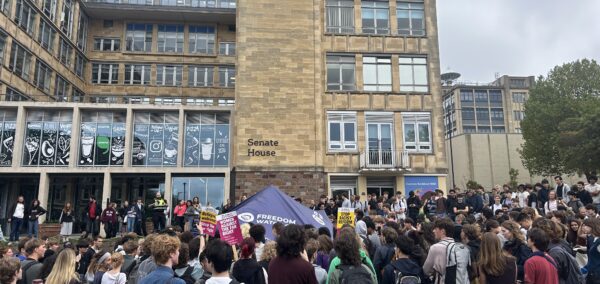
Far-right commentator driven off campus after clash with protesters

Students protested the presence of Montgomery Toms outside a University of Bristol study centre

We were barely born when Madeleine McCann went missing, so why can’t Gen-Z stop thinking about her?
‘Someone the same age as you never got to enjoy life as you have’

‘Am I gonna cry?’: Myha’la just found out who the Traitors are after being brutally banished
In the clip, Myha’la goes through so many emotions

Unite cuts the rent of some student accommodation, including in Nottingham and Sheffield
Unite struggled to fill rooms in some halls

Non-profit Enough distributes self-swap DNA kits at unis, but some students are concerned
Police warned ‘these kits can create false expectations’

Banished Celebrity Traitor Richard E Grant reacts to James and Maya’s roundtable betrayal
The Traitors did not stick together


Looking for a cheap night out in Manchester – here are the best spots the city has to offer

Happy hour spots for when your bank balance is low but a night out is much needed

Bella Ramsey on Celebrity Traitors made me nervous as a queer person, but then came Ross Kemp
They’re already shaping up to be a weapon at the roundtable


Lancaster city centre record store and coffee shop announces its closure

The business owners are ‘passionate about the local music scene’

The Celebrity Traitors rich list: The most loaded celebs to appear on the show, across both series
Some of them probs live in castles already

Yes Celebrity Traitor Richard E Grant is kooky, but the range of his roles already proved that
Turns out I’ve been watching Richard for years and didn’t realise it

The chunky net worths of the Celebrity Traitors’ actors, ranked from not bad to obscenely rich
I will happily accept their appearance fees