

Which crimes does Araminta arrest Sophie for? Bridgerton’s legal drama, properly explained
Omg, Sophie should have been executed
The seventh episode of Bridgerton season four ended on the huge cliffhanger of Araminta ordering Sophie’s arrest. But in the next episode, all these legal problems were resolved rather quickly, and Sophie moved onto making out with Benedict. So, which crimes does Araminta manage to get Sophie arrested for, and how does the Bridgerton family resolve this whole legal issue? Here are all the details of Bridgerton’s mini courtroom drama, explained step-by-step.
What crimes does Araminta accuse Sophie of?
Bridgerton season four theoretically takes place in 1816 (although, the timeline is very inconsistent). Under the “Bloody Code” in England and Wales, grand larceny was technically punishable by death. Grand larceny was defined as theft of items worth more than a shilling, which really isn’t much money. It was also a crime for servants to embezzle from their employers.
We know that the money Sophie got from selling the shoe clips covered passage on a mail coach to the Cavender family’s country estate. Establishing shots of the house resemble Bath’s real skyline. Getting the mail coach from London to Bath cost upwards of 18 shillings. So, in theory, Sophie could have been executed for stealing those show clips. Although, in practice, many judges in this era would undervalue what stuff was stolen to avoid the death penalty. It’s likelier that Sophie would have been deported to Australia as a punishment.
Araminta also argues that Sophie was “impersonating nobility”. This could be a crime… but Sophie definitely didn’t do it.

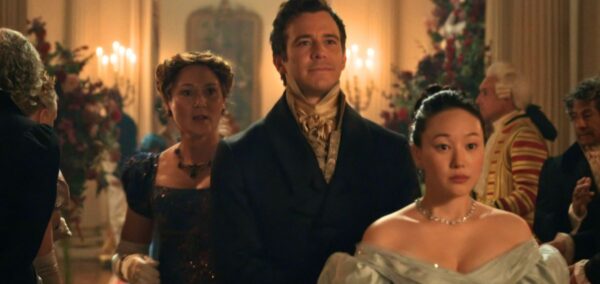
The luxurious-looking prison in Bridgerton
(Image via Netflix)
In the English aristocracy, technically only the people with titles are actual “nobles”. Anthony, Simon, John and Sophie’s dad are all peers, with seats in the House of Lords. (Although, John is the only one to even mention his job.) Everybody else is a commoner. The immediate relations of these people (such as all the other Bridgertons, and Lady Danbury) would have been considered the nobility social class. This group of people weren’t the only ones allowed at society events, though. The vast majority of people at these balls would have been members of the gentry class. These people owned land, and were still ridiculously privileged, but they didn’t have titles. They were another step removed from the royal family. Phillipa and Prudence’s husbands seem to be from gentry families.
So, Sophie definitely wasn’t impersonating nobility by going to Violet’s masquerade ball.



Personation was a serious crime in English law, but only if somebody had the intention of defrauding someone. Sophie didn’t plan to scam anybody – she was just admiring the party decorations. There is no way this counts as a crime. Araminta should go back to the drawing board.
How does the Bridgerton family resolve the legal problems?

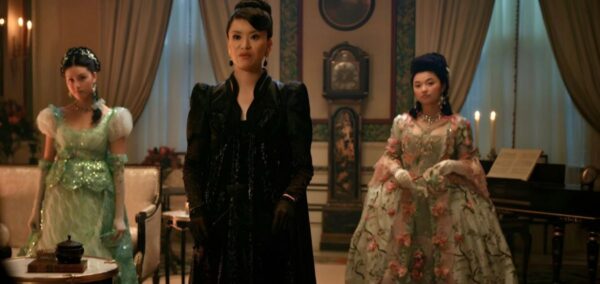
The real criminal mastermind is Violet
(Image via Netflix)
Essentially, by committing even more crimes. Violet figures out that Araminta planned to steal Sophie’s dowry, and give it to Rosamund. The Bridgerton family tell Araminta that they will reveal this to everyone, unless Araminta drops the charges against Sophie, and lies that Sophie is a distant relation of Lord Penwood.
This is definitely blackmail, which was also punishable by death in the 1810s. If the Bridgerton family put the name “Sophie Gun” on documents so Benedict can marry Sophie, that would also be a crime. Really, the Bridgerton family committed far more serious crimes than Sophie, Posy or Araminta.
Maybe it’s a good thing that Sophie decided to stop thinking about all this, and to get into a bath with Benedict instead.
Bridgerton is available on Netflix now. For all the latest Netflix news and drops, like The Holy Church of Netflix on Facebook.
Featured image via Netflix.

Latest

First week back at uni? Here’s everything you need to pack in your bag

Mary Poppins is quaking in her boots…

London university releases statement after professor sentenced for a child sexual offence

Barry Langford was a Professor of Film Studies at Royal Holloway



Young father-of-two died on day he was due to start at University of Glasgow

Young father tragically passes away at 24 years old after suffering a brain aneurysm

Bella Ramsey’s specific acting career gives them ‘an edge’ on Celebrity Traitors (they hope)
Their past roles have prepped them for Missions

12 of The Celebrity Traitors season two cast asked to be Traitors, and six to be Faithfuls
Three celebs couldn’t make up their minds

Maya Jama’s game plan for Celebrity Traitors is to avoid trying ‘too hard’ or ‘overthinking’
This is really devious tbh

Newcastle University buildings evacuated after ‘suspicious item’ found on campus

Police, fire crews, and fire engines arrived at the scene

12 things every Fresher gets wrong in their first few weeks at uni

From wearing your lanyard everywhere to leaving your washing-up until it grows its own ecosystem

Our Celebrity Traitors predictions include Maya Jama turning on her fellow Traitors

Here’s what we think will happen

I’ve just realised that three cast members from Celebrity Traitors were in Game of Thrones

Having flashbacks to Bella Ramsey being crushed by a giant




23 to 70: The ages of the Celebrity Traitors 2026 cast, from youngest to oldest

There’s a huge age range this year

James Blunt was a British Army captain before becoming a singer and joining Celebrity Traitors
He mentioned it on the show

Monster director finally admits why they forced Aileen Wuornos in a show about Lizzie Borden
Despite the name, Lizzie Borden is not the focus of the story

Shows and films you can watch about Aileen Wuornos, where she isn’t thrown into another story

Others tell her entire case, unlike Monster on Netflix

This viral tool lets you customise your Apple Pay cards, and here’s how to do it
You can personalise the entire design

James Acaster could be the Celebrity Traitors’ recruit, as filming reportedly paused for him
It’s not much of a cliffhanger

The ridiculous fortunes of The Celebrity Traitors: Their net worths, from £500K to £50 million
One of them could legit buy the castle three times over