

A brief history of cash-strapped UK universities merging – and which could be next
King’s College London will merge with Cranfield University
King’s College London (KCL) and Cranfield University just confirmed plans to merge. Large UK universities joining forces like this used to be an abstract idea. But as so many universities are making drastic cuts to courses and jobs, dramatic restructures a becoming more and more likely. Here’s a brief history of UK universities merging – and a look at which other cash-strapped universities might resort to desperate measures.
Various UK universities have merged in the past
University mergers aren’t unheard of – there just weren’t as many for a while. Many universities in the UK were formed from older, smaller institutions such as training colleges and mechanics’ institutes. In the 1980s, several medical schools were absorbed by universities.
A handful of UK universities did join together this century, too. The University of Manchester has only existed in its current form since 2004, when the Victoria University of Manchester and the University of Manchester Institute of Science and Technology combined. The University of the Highlands and Islands was formed in 2001 from several older colleges.
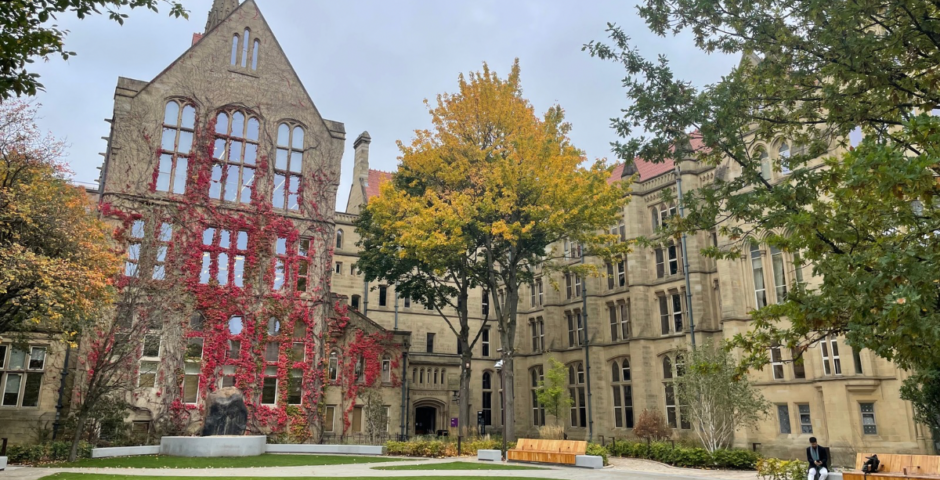
Manchester Uni’s oldest buildings were originally an education centre called Owens College
Many prominent universities in Wales were restructured in the 2010s. In 2013, the University of Glamorgan and the University of Wales, Newport combined to become the University of South Wales. The University of Wales Trinity Saint David is made up from several former unis. The University of Wales, Lampeter joined up with Trinity University College in 2010, then merged with the University of Wales in 2013, then absorbed Swansea Metropolitan University in 2013.
City, University of London and St George’s, University of London
City, University of London and St George’s, University of London joined together in August 2024 to become the even more verbose City St George’s, University of London.
St George’s was a long-established medical school, with just under 4,000 students. Mergers were proposed with Royal Holloway, University of London in 2008 and again in 2021, but fell through.
View this post on Instagram
According to a report from the Higher Education Policy Institute (HEPI), St George’s had been “breaking even”, but was in need of investment. City’s Chief Financial Officer, Matthew Swales, said: “Operating at scale gives you a level of resilience. In a challenging financial environment, diversification also reduces overall risk and means you are much more able to weather individual setbacks. That scale also helps with profile.”
The University of Greenwich and the University of Kent
In August 2026, Kent and Greenwich officially merged and became the UK’s first ever “super-university”. The new institution is called the London and South East University Group (LASE).
LASE now has over 50,000 students, making it the third-biggest uni in the UK. You can still apply to either the University of Kent or the University of Greenwich, and degree certificates will name one or the other. However, students can use facilities from both Kent and Greenwich’s campuses.

The University of Greenwich
The original announcement explained that “the combined entity will provide a strong financial foundation to weather current and future economic challenges”. The universities hoped “the collaboration will be a trailblazing model, establishing a first-of-its-kind multi university group, which will create a blueprint for other institutions to follow”.
In Kent’s accounts for the 2024/2025 academic year, it reported a statutory deficit of £5.6 million. That’s actually in improvement on the year before, when the deficit was £6.3 million.
Cranfield University and King’s College London
On 2nd November 2026, the Russell Group university King’s College London (KCL) and Cranfield University confirmed they would merge on 1st August 2027.



King’s is a much larger institution than Cranfield. 40,870 students enrolled at King’s for the 2024/2025 academic year, compared to 5,000 at Cranfield University. Most Cranfield students do postgraduate courses. The main campus is in a village called Cranfield, in Bedfordshire. It’s 50 miles away from KCL’s Strand Campus.
Cranfield will become a tenth faculty of King’s, called the Cranfield Institute of Technology. The university was called this between 1969 and 1993. It’s known for the Cranfield Defence and Security department, which is based at the Defence Academy of the United Kingdom at Shrivenham, Oxfordshire.
View this post on Instagram
Cranfield University’s business school will be combined with the King’s Business School, and become the Cranfield School of Management.
Anybody who is already a student at Cranfield University (or has accepted a place) on 1st August 2027 will be able to choose whether their degree certificate will name Cranfield University or King’s College London. Students who sign up after that date will get degrees from King’s.
King’s College London’s website says the merger is happening “to offer students a far more expansive, industry-woven experience through Cranfield’s extensive and deep industry connections”. The site pointed out that “Cranfield has access to unique facilities”.
The website also explains: “In merging with Cranfield, King’s, as the larger partner, will take on Cranfield’s assets and liabilities, including borrowing commitments.”
Cranfield University reported a pre-tax deficit of £8 million for the 2024/2025 academic year.
Could other UK universities merge to save money?
A survey by Universities UK from spring 2026 found that two out of five UK universities were open to, or were actively considering, merging with other institutions or joining up with other unis to become “multi-academy trusts”. Now, no other UK universities have publicly proposed mergers.
However, we can get a sense of which universities seem to be struggling with finances at the moment.

Nottingham on a nice sunny day
After its property was revalued, the University of Nottingham recorded an adjusted financial deficit of £85.3 million in the 2024/2025 academic year. Nottingham is cutting several courses, and scrapping modern languages.
In accounts for the 2024/2025 academic year, Coventry University reported a pre-tax deficit of £59.3 million. Coventry’s annual report said this was due to a big increase in student numbers, and the uni was “on course” to break even next year.
Swansea University had an underlying operating deficit of £39.9 million, and Cardiff University of £33.4 million. Queen’s University Belfast deficit was £22.8 million, and the University of Sussex’s was £22.7 million.
For more like this, follow The Tab on Instagram.

Latest

A brief history of cash-strapped UK universities merging – and which could be next

King’s College London will merge with Cranfield University

Leigh-Anne reveals her final Celebrity Traitors words were cut from the BBC broadcast

She made a cheeky comment

These are men you’re guaranteed to encounter at university in Leeds

From the underground DJs to the weekly Warehouse attendees, here are all the men you’ll meet
Man arrested following death of passenger in car crash near Lancaster University

The collision on Saturday 31st October resulted in the death of 88-year-old Alan Williamson

Sister of 20-year-old pilot in private jet crash speaks out and condemns ‘disrespectful’ posts

‘Please, this is the hardest moment’

Netflix series examines case of 18-year-old missing girl, with links to Amy Bradley

The three-part documentary is out now

James Blunt reveals Romesh Ranganathan donated to his charity after banishing him on Traitors
They’re both so wholesome

Why Green Boots still hasn’t been recovered from Everest months after deadline passed

The gruelling repatriation mission was supposed to take place this summer

Keep quiet to absolutely nothing: Celebrity Traitors stars reveal what they’d do differently
Hannah Fry is fully ready to renounce her PhD

Gary has addressed his ‘unfair’ Bake Off exit, after people insisted he deserved to stay
Gary, we ride at dawn

Lancaster locals go behind bars to raise money for charity

Jail and Bail 2026 sees locals jailed in Lancaster Castle to raise money for St John’s Hospice

20-year-old Learjet co-pilot posted videos flying same plane months before Florida crash
Her TikTok handle is ‘@learjet_girl’

Paris Jackson demands $600million from Michael’s estate and claims executor is withholding inheritance
The estate has clapped back

Christa Pike’s rare cancer has been made public, and courts were told months before execution
The lawyers argued her cancer could complicate the execution

Three months on from livestream, Perez Hilton enters ‘next phase’ of extensive treatment
He’s staying in supportive housing

University applicants’ visas rejected for interview questions on trees and Canadian weather
Some student visas were denied for ‘very strange’ reasons

The cafe in York giving second chances: Chocolate&Co helping people affected by addiction

A York cafe has been recognised for its work supporting people recovering from addiction by giving them opportunities to get back into work

‘It’s more than just a stache!’: An inside look to Movember at York 2026

Your guide to what Movember is and how you can get involved!

Green technology agreement signed by York University and Karnataka state
The University of York has signed a Letter of Intent with the government of Karnataka to build innovation in green technology
University of York graduate designs new seasonal jobs app

University of York graduate designs new app designed to make the seasonal job hunt easier