

Review: Hamlet dominates King’s Chapel
Sultry, surprising, and stylish: Evie du Bois’ Hamlet is a director’s genius on full display

Last week, I found myself in King’s Bar, where a gaggle of flustered young women were gathered round a table, muttering in hushed tones:
“I just don’t think he’s emotionally ready for a relationship.”
“I could fix him, and besides, he’s the prince of the Denmark.”
Angling over to discern who they were talking about, anticipating naturally that it would be a culprit from Pembroke, I noticed four playbills for ‘Hamlet in the Chapel’ on their table.
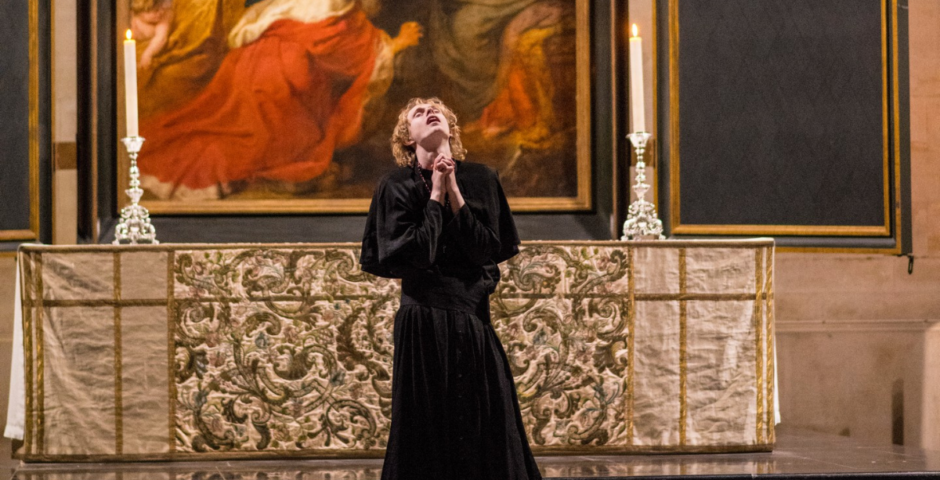
Emblazoned across the cover was the subject of their (and seemingly the entirety of Camfess’) admiration. Brooding, dark, and adorned religious paraphernalia, King’s Chapel dominated the cover of the programme, and from then on, my mind.

Image Credit: Dik Ng
Hamlet in the Chapel, directed by King’s Evie du Bois, reimagines Hamlet as a young Priest in a Church that seems to slip closer to sin with each passing day. Following the death of the past Head of Church and State, in lieu of a conclave, the King’s brother takes the Zuchetto, leaving young Hamlet with suspicions around the circumstances of his father’s death. You know what happens next – we’ve all seen The Lion King – except here the ghost appears to a fantastic original Choral score by Rich Mandel, and everyone acts much more bestial.
Du Bois’ Hamlet succeeds where others have failed in her recontextualising of the play. Cutting down the full text from over four hours to just under two, her Hamlet is fast-paced and action-packed. Rather than mainly cutting scenes, she’s instead focused on cutting lines, allowing the play to run in its entirety – thus, what shifts is not plot but emphasis. This Hamlet is not about revenge or mortality, but instead the male ego and violence which emerges from it.
The heart of this emerges in Act III, Scene I, where Ophelia -played hauntingly by Annie Rainbow– confronts Hamlet over his madness and their affections for each other. Here, Hamlet offers her not just a verbal rebuke but a physical one. In this implied scene of rape, the audience sheds any empathy for Hamlet, and instead, that is replaced by fear. Only two scenes later, when Hamlet attacks his mother only to be stopped by his father’s ghost, we might anticipate a similar action occurring- from this point on, there is alarm rather than amusement around Hamlet’s unpredictability. There is thus a great discomfort when Hamlet later reappears, resting his head on a distressed Ophelia and musing of innuendo to her.
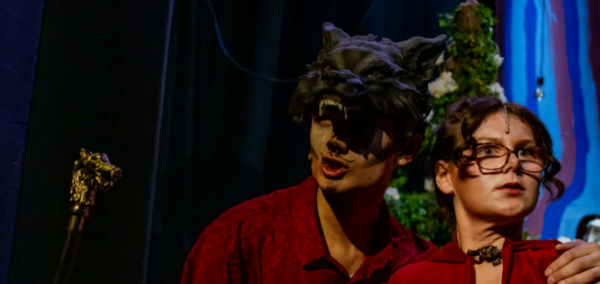
In a post-Everyone’s Invited age, du Bois’ Hamlet is no longer a tragic hero but a young man who has weaponised his anger and his privilege to cause harm to those around him without consequence. It is telling that only Ophelia’s death, not that of Polonius, nor her earlier implied rape, nor Hamlet’s earlier actions towards his mother and friends, is enough to drive Laertes to seek revenge. As an audience, we too, don’t reassess him till the extent of the impact on Ophelia is truly revealed in her death. Perhaps here intended as a failure to recognise the symptoms of dangerous men before the damage they do is irreparable, the choice to cast the foppish Harry Lloyd Yorke is a masterclass of casting. No one expects him, with a sort of Scandinavian Hugh Grant appearance, to be able to enact the destruction he does.

Image Credits: Dik Ng
This adaptation is a contorted dance between Harry Lloyd Yorke and King’s Chapel, the space both promoted and consumed him, at times the echo of the acoustics shrinking him to a diminutive and petulant boy, then thrusting him forth as an angry and driven leader. Candlelit in the darkness of the space, his shadows leap forth with erratic and jaunty movements, and yet the looming giant order of the chapel reminds us just how diminutive he really is. It seems an impossibility to compete with one of the most iconic buildings in the world, and yet Lloyd Yorke does it; his Hamlet is a declaration that he is here, not as a future star, but one who has arrived.

The chapel is an actor in its own right, recontextualising the play in a freshly religious context. Its very setting is a constant reminder of the sin of our characters and their desperation for redemption. No clearer is this than in Nick Danby’s Claudius, exuding all the charm of a Southern preacher. He makes us believe in Claudius’ innocence against our better judgment. In a world of charismatic worship, Danby co-opts the manipulation of the general audience through exaltation to religion (a tacit reference to the American right). In an almost eight-minute monologue, Danby’s charm and composure collapses and we see the bitterness and fear he truly has. It is hard not to think of public figures such as Charlie Kirk in Danby’s performance, his Claudius- just like Lloyd Yorke’s Hamlet- is a destructive male authority who spirals increasingly out of control.

Image Credit: Dik Ng
Claudius’ foil in du Bois’ production is not the titular character but instead the ghost of his father, played with bone-tingling eminence by David Jorgenson– also an American. If Claudius is the far American right, harming others in the name of personal ambition, I see Jorgenson’s ghost as the American populist left, so adamant in their pursuit of justice that they cannot recognise the destruction that indiscriminate calls for a populist vengeance strategy can be just as harmful. His performance is tinged with anger and, towards the end, wistful regret. In these juxtaposing visions of American leadership du Bois could be asking us what sort of Church we want to engage with: one of order built on injustice and manipulation, or justice built on chaos.
They are supported by Will Barber as a sycophantic and bumbling Polonius, playing the character as an apathetic and opportunistic grifter, desperate to get ahead. Barber’s physical acting was fantastic, and he transformed himself into a saline figure, ever jittering and morphing depending on who he was addressing. The brief moments of solitude show Polonius’ true nature and a Machiavellian archetype, not a fool, and it is a testament to Barber’s performance and du Bois’ direction to strike such a fine drawn balance.

Image Credit: Dik Ng
The supporting cast all offer strong performances. Jacob Smith’s Horatio is deeply empathetic, anchoring the audience in the world of the church, and du Bois’ choice to have Horatio’s grief, not Fortenbras’ arrival, end the play allowed Smith to shine in a downturn moment. It was a shame to see so many of his lines cut from this adaptation, as his performance was truly moving. Ben Birch and Edward Badege were side-splitting, indistinguishable as Rosencrantz and Guildenstern, leaving me desperate for a Tom Stoppard adaptation instead of a Shakespearean one.
Sophia O’Callaghan and Archie Giblin put on strong emotional showings as Gertrude and Laertes, respectively. O’Callaghan offered a quietly conflicted Gertrude, in contrast to the vociferous performances of others, a troubled and complicit bystander. Giblin had the difficult task of nailing deep anger without falling into the bracket of over-acting and perfectly balanced his anger with restraint and eventual clarity. Mia Badby and Dylan Hughes took on a variety of ensemble roles and offered strong performances; They have bright futures on the Cambridge theatre scene.
The true standout of the supporting cast, however, was Aisling Martin in her performance as the Player Queen. In her performance of the tale of the fall of Troy, she held a mastery over the acoustics of the chapel -the only performer not to be swallowed in its echoes- and delivered each line with a lyricism and musicality which played heartstrings like a harp.
The true but literally sung hero of the play was Rich Mandel, who composed an original score and musical motifs for each character. Sung by the King’s Voices, Mandel conducted not just the choir but the audience’s mood and feelings. The combination of music and theatre was an ethereal coupling which fully capitalised on the space the chapel had to offer.
The Play’s director, Evie du Bois, has secured herself the status of a genius of theatrical direction. The achievement of not just tackling the most iconic and complex of Shakespeare’s tragedies but reimagining it as something wholly original suggests a wisdom and accomplishment well beyond her years. The cast may have some future stars in its performers, but du Bois has established herself as one of the premier minds of not just Cambridge, but British theatre, should she continue down that path.
5/5
Featured Image Credit: Dik Ng

Latest

Great British Bake Off’s first eliminated baker Danni has spoken out since leaving the tent

They’re pretty happy with how it all went

Rita Ora sued by her former manager in £3million legal battle over missing tour and TV cash

‘It’s sad it has had to come to this’

‘No remorse’: Victim’s mother speaks out as Christa Pike set to be executed after 30 years

She is travelling to Tennessee to witness her execution

Reality TV star found guilty of murdering wife after his AI songs about affair played in court

The woman he had an affair with testified against him in court


How to spot a nightmare flatmate at UofG

Recognise the red flags early and save yourselves from hell


The Glasgow Uni Freshers starter pack

Essentials only… and some extras obviously cause we all need a treat

Sarah Paulson shares why playing Aileen Wuornos in Monster left her genuinely scared
She’s played witches and monsters, but the Lizzie Borden show was daunting

Justice for Mrs Borden! Every egregious lie Netflix’s Monster told about Lizzie’s stepmum Abby
Netflix turned victim into villain
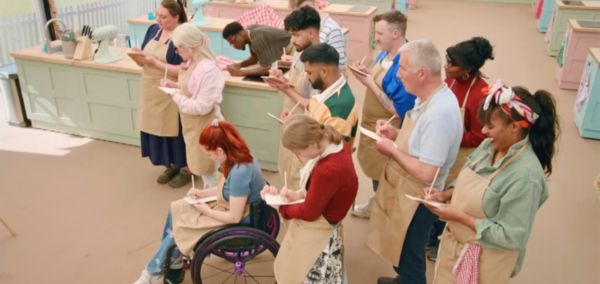
Where the vibey Great British Bake Off 2026 cast went to university, and what they studied

Two contestants were uni students during the show
Newcastle University faces criticism over appointing oil billionaire as sustainability professor

‘Universities are supposed to be places that question power and hold corporations to account’
Director on why difficult scene in The Lizzie Borden Story made Netflix crew cry
‘It was really humbling’
Shannon left the Bake Off tent due to ‘something that really frightened her medically’
‘It was unexpected and scary’
The Cornell case is horrific, but sexual violence on campus is not just an American issue
The allegations are a reminder that university sexual violence is everywhere

Where the iconic Lizzie McGuire cast are now 25 years on, from Adam Lamberg to Hallie Todd
Hilary Duff just did five tour dates in the UK

New Cornell fraternity group chat messages have surfaced as the criminal case is reopened
The messages are from a Snapchat group

‘In an amazing place’: Inside wholesome life Ariana Grande is now enjoying away from the public
When she will be back has also been shared
Lizzie Borden’s neighbour who was first at murder scene spoke in court about what she saw
She was there before the doctor
Monster skipped the real Lizzie Borden’s attempt to buy poison the day before the murders
It became trial evidence