

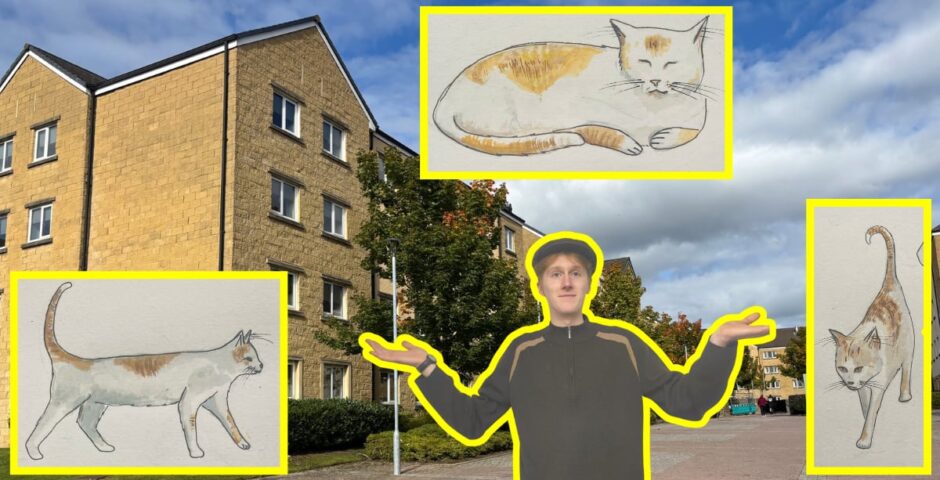
I stumbled across a calico cat in Lancaster’s Grad college, but he’s vanished ever since
A mystery cat’s brief reign and sudden disappearance

I was sitting in Fylde college common room when I overheard the news.
There were reports from Graduate College of a new cat on the block.
On Tuesday morning, a white cat swanned in to the porters office. After sniffing the windowsills, ledges and corners, it curled up on the chair by the radiator and went to sleep.
On finishing my lecture I hurried down to Graduate College, in the hope of meeting the cat. However, seemingly unaware of the stir it had caused amongst the staff, it had wandered off shortly before I arrived.

An illustration of Millicent the cat
The cat is white and brown, and has received the nickname Millicent from one of the cleaners.
I returned the next day and the cat was again nowhere to be seen.
On my third inquiry I was beginning to feel slightly silly. Each time, however the subject brought up admiring stories from the porters about the previous feline celebrity, Guinness. Known for his black coat and at times fierce temper, he was revered and feared by porters throughout the campus, and was known to stray as far as County College.
“I remember one Christmas…” reminisced a porter: “It must have been only me and Guinness on campus that day! I knelt down as he came over – the honour I felt when he let me stroke him, he wasn’t always friendly you know.”
Indeed, in other stories it was his teeth and claws which made the impression.
Guinness lived in Galgate until about a year ago. The owners, aware of his ventures to campus, informed the university that they were moving house and he has not been seen since.
The elusive Milicent is of unknown origin, but many suspect a similar story. However the idea that the cat belongs to someone on campus has not been ruled out.



Millcent in motion
So why do cats roam from the comfort of their homes to Lancaster University? Galgate is over 2 km from campus, which seems a long way for such small animals.
Much research has been done into roaming cats and while most tend to have a range of under 1km, it is not unheard of for them to reach 8km. There are a variety of reasons why a cat might turn up at the university.
– Hunting is a common cause of cats exploring further afield. This is not only a source of food but also a brain stimulating exercise. It is worth remembering that for much of history, cats were kept in order to catch rodents. Consequently those with hunting skills survived the best. Unlike dog,s there has been less selective breeding with cats, so their hunting instinct remains strong.
– Looking for a mate. Research shows that un-neutered cats typically stray furthest and males further than females.
– Seeking security. Cats may seek new places when they feel anxious at home, because of factors such as introduction of dogs, or other changes such as construction noise.
– Exploration. As naturally inquisitive creatures, it is usual for cats to explore other areas, keeping their brain active and engaged. Interestingly, urban cats do not adventure as far as rural cats due to more neighbouring cats, physical barriers as well as more readily available food.
– Territory. Cats often spend time simply patrolling their territory, renewing spray marks and seeing off rivals.
We are perhaps witnessing an exchange in cat territory, but while the scent of Guinness may be beginning to wear off, his memory lives on with many of the Lancaster University staff.
I am still yet to have seen the cat. If anyone sees him and takes a photo, please send them to The Lancaster Tab Instagram account.
For more of the latest news, guides, gossip, and memes, follow The Lancaster Tab on Instagram, TikTok, and Facebook.



Latest

More than two tonnes of plastic pellets may remain in the Tyne, researchers warn

A collision in July released around 17 tonnes of nurdles

Jax speaks out after toe-curling Love Is Blind reveal, and shares why she *really* ghosted Stew

She claims it had nothing to do with his appearance

A full record of how The Celebrity Traitors S2 cast voted at each Round Table session

Yup, we’re keeping track of all the stats

The Celebrity Traitors comedians whose fortunes are no laughing matter, from £1m to £6.5m

The fact Miranda isn’t the highest is criminal

Celebrity Traitors’ King Kenny was arrested after filming a prank on his university campus

He has a wild backstory from his YouTube career
Is this the downfall of Turnitin? Here’s what you need to know

Turnitin’s system is changing and students’ data could be used to train tools which use Artificial Intelligence

Fewer apps, more life: My experience at the launch of the social SuperApp ZYMIX

Inside the launch of the SuperApp that wants to clear out your home screen

The question we’re all thinking about: What exactly is happening with the library?

Everything you need to know about the JB Morrell Library refurbishment

Plans submitted to council for new research facility at York University

University of York’s Campus West could see a new research building after plans submitted to York Council

Wait, why was Barack Obama in Manchester city centre?

The former US President was spotted outside a hotel before speaking at Co-op Live

The Celebrity Traitors producers are already eyeing up big names for season three’s cast
Stephen Lambert wants Tom Cruise and ‘a big sports star’

Hannah Fry has crunched the numbers, and spotted a suspicious Celebrity Traitors voting pattern
It could be bad news for the Traitors

Former Lancaster University professor John Whitehead dies aged 76

John was a lecturer of mathematics and statistics

How to avoid the struggles that come with a part-time job at a Bristol university

After all, we do live in on of the most expensive cities in the UK.

All the public scandals The Celebrity Traitors cast have been in, from arrests to racist tweets
They’re not as wholesome as people think
Newcastle and Northumbria universities join forces for new Student Health Hub

Students of both unis can access the mental health service on Friday mornings

The net worths of the American Horror Story 13 cast prove who desperately needed that pay cheque
A $50 million net worth with two minutes of screentime? Nice

Three UK universities announced language course closures in 2026 – including Edinburgh
The University of Edinburgh is scrapping 90 programmes

‘She is phenomenal’: Traitor Hannah Fry has realised that she’s related to her co-star
‘I cannot tell you how much I admire her’

From Crawford to Turing: the stories behind UoM’s building names

You’ve walked past them loads, but how many names do you truly know?