

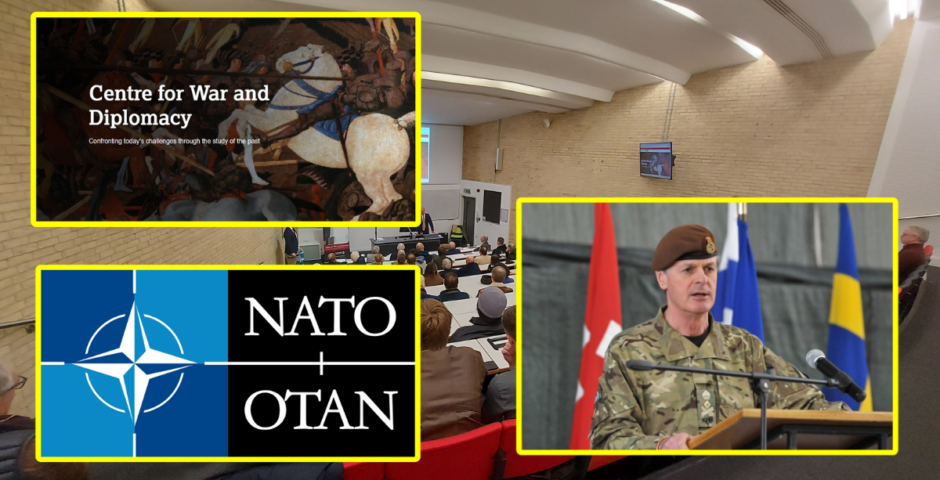
Former NATO commander gives speech at Lancaster University
The former Deputy Supreme Allied Commander spoke about the war in Ukraine and what it means for the UK and the security of Europe

On Wednesday 19th November, former deputy supreme allied commander of NATO, Sir Richard Shirreff, gave a speech at Lancaster University.
The talk highlighted the precarious nature of European security, the wider implications of the war in Ukraine, and drew attention to the UK governments increasingly strained budget.
The Martin Edmonds memorial lectures are a university tradition following the passing of the late Martin Edmonds in 2018, a Lancaster University lecturer esteemed for his expertise in defence studies. The lectures primarily focus on military history, defence and security, and international relations.
Richard himself has an extensive and decorated background in NATO and the military, and served as deputy commander of NATO from 2011-2014, publishing a visionary book titled 2017 War With Russia: An urgent warning from senior military command that warned of Russian aggression in Eastern Europe.
The former NATO commander began the talk with an anecdote about his initial thoughts upon receiving the invite to give the lecture, returning to his time in the army during the Gulf war. He spoke of three men in his troop whom he nicknamed The Lancaster mafia. “And to my dying day, I shall have the greatest respect, affection, and I owe such a great debt to those Lancashire men”, he said, as he dedicated the talk, in part, to them.
Describing Putin’s Russia as “a twenty-six-year regime defined by war”, Richard made his position as staunchly anti-Russian clear from the outset. He cited not just the war in Ukraine from 2022 onwards, but prior patterns of Russian aggression, including conflicts in Chechnya and Georgia in 2008, as well as Crimea in 2014.
Voicing his concerns that Vladimir Putin’s actions have faced a lack of consequence for military aggression, Richard then discussed his views on Trump’s warm reception of Putin despite the war in Ukraine. He said: “And when I see an indicted war criminal on the red carpet at an Alaskan air base on US soil being greeted by the US president, it looks to me as if he will get away with it again.”
The former NATO commander spoke about Russian interests in Ukraine, making it clear he did not believe Putin would be satisfied by a partial victory in Ukraine. “[Putin] wants the lot”,” Richard said.
He continued: “If you want peace, prepare for war” – the response he believes the West should be taking.
Quoting the classic Latin adage, Richard said: “The only way we prevent war is to be strong. The way we invite war is to be weak.”

The speech was held by the CWD in the Margaret Cavendish lecture theatre
The discussion then moved into a Q&A, where several of Richard’s claims were challenged or expanded on.


He criticised the government’s current military expenditure, saying: “Our leaders have got to get a grip in this country, particularly of bloated welfare spending, our social security spending which completely cramps any efforts to increase defence spending.”
The NATO commander further added that looking to Eastern Europe is the solution. He cited Poland spending five per cent of its annual budget on the military, the highest in NATO. This was compared to the UK’s current 2.4 per cent spend (approximately £62 billion). The current Labour government aims to be spending 2.5 per cent by 2027 and 3.5 per cent by 2035 – targets Richard felt were a bare minimum, and coming too late.
When questioned on the size of the army, he pointed to Finland as his ideal solution: “Not only is the notion of universal male conscription completely accepted, it’s a badge of honour.”
Later, he was pressed further on his description of Russia as “imperialist”. One student said: “Outside of Western Europe, the West narratives don’t land. They are just seen as hypocrisy, the invasion of Iraq, which was an act of aggression not sanctioned by the UN Security Council, [based] on completely made up intelligence. And we use the same rhetoric, accusing the Russians of exactly the same thing”
Richard responded by saying there are “no easy answers” to the issue; however, he made clear his position on Iraq. “History goes on. As a soldier, you either turn to the right, get on with it, or you resign. I turn to the right”, he said, referring to his time in Iraq around 2006 during the rebuilding period.
On winning the propaganda war against Russia over Ukraine, despite the West’s failings – such as the 2003 invasion of Iraq – the former NATO commander said: “The only way to do this is for the Ukraine voices to be heard.”
Following the talk, The Lancaster Tab managed to fit in two questions – one being clarification on a book he recommended – Defeat into Victory by William Slimm, the second regarding Richard’s position on the British government arming Israel amidst waning military support due to the conflict in Gaza.
Considering that garnering public support for the military and defence spending was a major point of his talk, The Lancaster Tab questioned the former NATO commander on whether arming Israel has harmed support for the defence industry.
Richard said: “Tough love for Israel. Israel has the right to defend itself. It does not have a right to colonise the west bank; it does not have the right to break international law”.
For more of the latest news, guides, gossip and memes, follow the Lancaster Tab on Instagram, TikTok, and Facebook.
Featured images via Sophie Therese Ambler, NATO and the Lancaster University centre for War and Diplomacy



Latest

A guide to treating the Sunday scaries in Selly Oak

Battling a Circo hangover with the impending doom of a 9am lecture? Welcome to an average Sunday in Selly Oak

More than two tonnes of plastic pellets may remain in the Tyne, researchers warn

A collision in July released around 17 tonnes of nurdles

Jax speaks out after toe-curling Love Is Blind reveal, and shares why she *really* ghosted Stew

She claims it had nothing to do with his appearance

A full record of how The Celebrity Traitors S2 cast voted at each Round Table session

Yup, we’re keeping track of all the stats

The Celebrity Traitors comedians whose fortunes are no laughing matter, from £1m to £6.5m

The fact Miranda isn’t the highest is criminal
Celebrity Traitors’ King Kenny was arrested after filming a prank on his university campus

He has a wild backstory from his YouTube career
Is this the downfall of Turnitin? Here’s what you need to know

Turnitin’s system is changing and students’ data could be used to train tools which use Artificial Intelligence

Fewer apps, more life: My experience at the launch of the social SuperApp ZYMIX

Inside the launch of the SuperApp that wants to clear out your home screen

The question we’re all thinking about: What exactly is happening with the library?

Everything you need to know about the JB Morrell Library refurbishment

Plans submitted to council for new research facility at York University

University of York’s Campus West could see a new research building after plans submitted to York Council
Wait, why was Barack Obama in Manchester city centre?

The former US President was spotted outside a hotel before speaking at Co-op Live

The Celebrity Traitors producers are already eyeing up big names for season three’s cast
Stephen Lambert wants Tom Cruise and ‘a big sports star’

Hannah Fry has crunched the numbers, and spotted a suspicious Celebrity Traitors voting pattern
It could be bad news for the Traitors
Former Lancaster University professor John Whitehead dies aged 76

John was a lecturer of mathematics and statistics

How to avoid the struggles that come with a part-time job at a Bristol university

After all, we do live in on of the most expensive cities in the UK.

All the public scandals The Celebrity Traitors cast have been in, from arrests to racist tweets
They’re not as wholesome as people think
Newcastle and Northumbria universities join forces for new Student Health Hub

Students of both unis can access the mental health service on Friday mornings

The net worths of the American Horror Story 13 cast prove who desperately needed that pay cheque
A $50 million net worth with two minutes of screentime? Nice

Three UK universities announced language course closures in 2026 – including Edinburgh
The University of Edinburgh is scrapping 90 programmes

‘She is phenomenal’: Traitor Hannah Fry has realised that she’s related to her co-star
‘I cannot tell you how much I admire her’