Everything you missed at the Durham Union Mock Election
The Young Greens won by an outstanding majority of 55.2 per cent
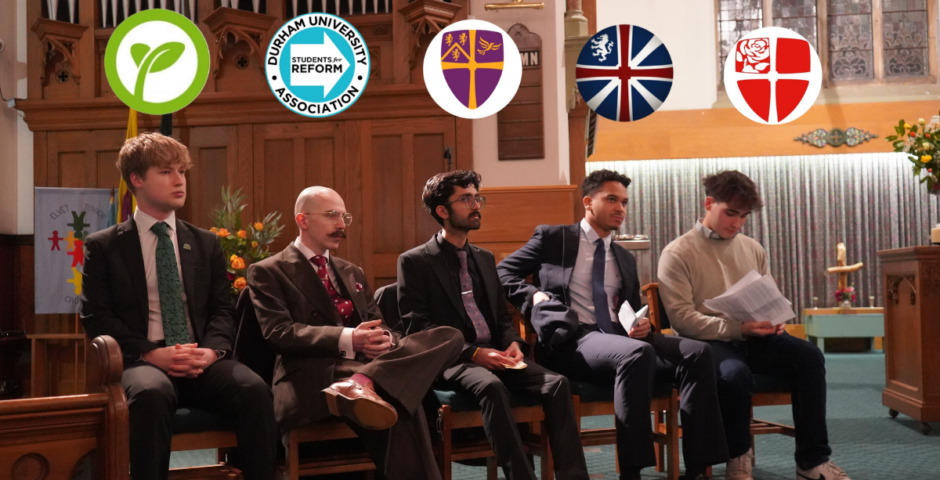
On Friday 30th January, the Durham Union hosted a student party mock election at Elvet Methodist Church, inviting the respective society presidents of the Conservatives, Labour, Liberals, Reform and Green alike, to debate.
Each of the young leaders was invited to deliver a speech, take questions from the floor, and hear from other society representatives as part of their individual campaigns. They all took to the stage to showcase their political parties’ policies, and perhaps gave listeners (and The Tab readers) an insight into what joining each society would actually look like. Let’s see if you’re convinced…
What did the event entail?

The Durham Union invited youth leaders from all five main political parties to represent their societies in a debate over pressing issues of the day, before the audience decided who was hypothetically best placed to tackle them.
The event was open to all and saw the venue reach near-capacity, widening the electorate, which chose the Greens as Durham’s winner. This was particularly telling as the Durham Union is often renowned for its right-leaning nature, given the demographic of many of its members.
The results

The Young Greens won by 55.2 per cent, followed by the Conservatives, with 19.9 per cent. The Liberal Democrats came third, with 9.6 per cent, and Labour scored 5.7 per cent. Reform UK came last.
261 people voted, and the event was open to all, broadening the union demographic in what was a highly successful night for the Greens.
First place: The Young Greens (Isaac Short)

Chair of the Young Greens, Isaac Short, represented the Green Party of England and Wales, presenting it as the “true left-wing alternative”, focused on rebuilding public services, tackling inequality, addressing the cost-of-living crisis, and rejecting privatisation and wealth concentration.
He briefly opened with immigration, arguing that other parties overly fixate on this. He instead proposed finding a more humane system, while dismissing open borders too.
Ultimately, he presented the Greens as the party offering hope and structural change without extremism, in order to “make hope normal again”.
Green policies
- End NHS privatisation, as energy, water and transport have failed. Services should be publicly owned, and run “for people, not profit”
- Invest in hospitals and primary care
- Guarantee GP and dentist access
- Increase mental health funding
- Place a paid counsellor in every school
- Raise the minimum wage to £15 for all ages. “Unless you’re a literal billionaire, I am not [taking money off you].”
- Re-join the EU
- End Right to Buy
He emphasised the importance of the NHS, as “people are still dying in corridors”, stressing the need to “rebuild the greatest achievement a British government has ever accomplished… We want to rebuild our NHS”.
The Young Greens released a statement on Instagram, stating “we are pleased to announce that we won with a 55.2 per cent majority – thank you to everyone who attended and voted to support the DU Young Greens. Make hope normal again”.
Second place: Durham University Conservative Society (Sean Smith)

The Conservative Party was represented by their acting-president, second year history and politics student from South College, Sean Smith.
He argued “protest is not policy, and slogans are not strategy. The Conservatives offer the clearest route for an economy that works, backs enterprise and manages public finances in a responsible manner”.
Sean criticised the Green Party’s approach to “fiscal discipline” as a “straight jacket”.
When asked by The Durham Tab how he felt about the result, Sean said: “I’m very pleased that DUCUA finished second, and it was a far greater position than I anticipated. I feel this reflects that conservative values and moderation remains resilient among our student body”.
Conservative policies/ track record:
- Credibility in government is earned, not asserted
- Nearly 4 million new jobs created
- Employment rose – 74.5 per cent, 33 million people in work by 2024; this was not accidental, but the result of deliberate policies to “make work pay”
- Meaningful tax relief for working people
- Biggest cuts to national insurance contributions – £900,000 a year
- Not “abstract fiscal decisions, but practical measures”
- Wages rose – national living wage up during Conservative government, lifting the pay of millions, boosting the earnings of up to 2 million people
- Real improvement in public outcomes – Schools rated Good or Outstanding up from 68 per cent under Labour to 90 per cent under the Conservatives
- Crime fell by 50 per cent compared to 2010 – not marginal gains, but transformational improvements
The Conservatives’ environmental goals centre on the belief that economic growth and climate responsibility are not mutually exclusive. It advocates a model of “pragmatic environmentalism,” aiming to halve emissions while continuing to grow the economy, arguing that prosperity and sustainability must go hand in hand.
It emphasises economic and strategic responsibility, positioning themselves as focused on stability and growth.
Its agenda includes abolishing stamp duty for primary residents and breathing life back into local economies, presenting these measures as part of a broader strategy to strengthen communities while delivering environmental progress. Sean argued “the case for voting Conservative is the strongest”, arguing Tories offer a serious, credible plan which promises economic dynamism.


Third place: Durham Liberals (Prem Raghvani)

The Durham Liberals were represented by their president, second-year natural sciences student from Josephine Butler, Prem Raghvani, He argued politics should be based on “freedom and fairness”, presenting the party as the balanced, economically responsible alternative that protests civil liberties, invests in education and the environment, and delivers practical results.
The system should be levelled so starting circumstances don’t define outcomes, arguing “you can’t have real freedom without fairness. Freedom means having the chance to build a life through your own effort”.
Prem acknowledged free tuition is currently unrealistic due to public finances, calling for maintenance grants, and supported university research and mental health services, as well as the return to the Erasmus+ scheme.
Liberal Democrat policies
- Strong stance on environmental protection for future generations
- Support for properly funded public services
- Focus on prevention in healthcare
- High-quality mental health services for students
- Tax super-profits (bank, oil and gas)
- Reverse tax cuts for big banks
- Windfall taxes on oil and gas companies
- Pointed to strong record in County Durham
- Opt-out free school meals, delivering practical improvements
- Supports infrastructure and Net Zero projects
When asked about the result, Prem said: “Placing third, ahead of both Labour and Reform, confirms that our core message of Freedom and Fairness truly resonated with the room. While we avoided the flashy claims seen elsewhere, we offered a Fair Deal for all, grounded in economic reality”.
Fourth place: Durham University Labour Society (Robbie Bono)

Labour was represented by the Chair of the Labour Society, third-year Economics student from St Cuthbert’s Society, Robbie Bono.
The speaker had a difficult task ahead of him in defending the Labour Party’s incumbent position after 18 months in power. He contrasted Labour’s “pragmatism”, with oppositional “populism”, calling for voters to stay loyal despite early changes.
He admitted: “I know that we have made mistakes”, but “I have never been more certain that a Labour government is exactly what Britain needs.
“Only the Labour Party has both the values to dream of a better future, and the pragmatism to make it happen”.
When speaking to The Durham Tab on Labour’s defeat, Robbie told us: “We knew this would be a challenge. Labour’s historic and well-earned reputation as the party of the young people has been weakened by the rise of the Greens. We must meet that challenge head on – not by rejecting the politics of hope, but by reclaiming it and making it unmistakably our own once again. The time for Labour to be bolder and more ambitious is now”.
Labour policies
- Belief in society and collective responsibility
- Strength measured by support for the vulnerable
- Long-term rebuilding requires patience
- Wage rises for low-paid workers
- Major expansion of workers’ rights
- Large house-building programme
- NHS improvements, including 5 million extra appointments, waiting lists down by 300,000, and faster ambulance response times
- Rail nationalisation
- Renters’ rights reforms
- Ending the two-child benefit cap (lifting 500,000 children out of poverty)
- Defends raising money from private schools (ending tax exemptions) and the wealthiest farms, arguing this is fairer than taxing working people
For Robbie, “we are already making a difference to people’s lives”.
He urged loyalty and patience, framing Labour as the only serious governing party capable of rebuilding Britain. Robbie made this message clear, concluding “tonight is not the time to turn back. Tonight, you need to vote Labour”.
Fifth place: Reform UK (Xavier Hale)

Reform UK was represented by Durham student, Xavier Hale. He argued: “There is a solution, there is Reform”.
He explained: “Reform is not perfect. Is it trying to be? Not really”, adding “my party has its problems, but it also has its merits”
Reform policies
- Cut council tax, and then undoing this promise
- Proposes economic changes – cuts in taxes, spending, etc. He pointed to Pride parades and Lumiere in Durham as “luxuries”, emphasising the importance of “necessities” like bus stations
- Investment into renationalisation of industry, “bringing back industry we no longer have”. This is why we no longer have jobs
- Immigration – “Don’t allow criminals in. If you’re not useful, bugger off. I know these are rich words coming from an immigrant myself, but the truth is, perhaps I should deport myself”
Reform’s Durham society failed to comment on their electoral defeat.
For more of the latest news, guides, gossip, and memes, follow The Durham Tab on Instagram, TikTok, and Facebook.
Latest

‘I don’t remember’: American Airlines passenger duct-taped to plane seat speaks out for first time

He called the whole thing a ‘mess’
There’s one ‘dangerous’ detail in the Ed Sheeran scandal that a politician says we’re overlooking

Alexandria Ocasio-Cortez is right… once again
Cambridge college informs students they can’t move into their chosen rooms when term starts

Affected students will receive compensation estimated to be £400
Health expert reveals how dangerous HYROX poop incident really is after ‘biohazard’ concerns
Everyone’s right to be freaking out
New one-day Lancaster music festival cancelled due to financial hardship after months of postponement

Rapper Tinchy Stryder was supposed to make a headline appearance at the event
Explaining that resurfaced video of Macklemore ‘mocking Jewish people’, and how he responded
‘If this guy is your human rights hero, you’ve got a serious problem’
Very few celebs are publicly backing Ed Sheeran, but the ones who are speak VOLUMES
Alexa, play clown music
From University of Edinburgh Student to Edinburgh Councillor, Ruth Elliot Reflects on her Journey into Politics

In a conversation with The Edinburgh Tab, Ruth Elliot discusses student life, her role as Vice President Community, and her goals as councillor
Slow Horses season six isn’t the same, so here’s why the show’s creator Will Smith quit

‘I sadly couldn’t keep going’

Bonnie Blue’s video birthday messages to 16-year-olds are the final nail in the coffin
‘Maybe one day, me, you, and your dad can take a trip’
It’s been a whole 10 years since This Is Us started, so here’s where the cast are now
Justin Hartley re-married in the same year he divorced Chrishell Stause
HYROX has actually just added new ‘faeces’ rule, so here’s what it means for athletes

Joanna Wietrzyk should consider herself lucky
Calling all aspiring journalists and content creators: Join The London Tab!

Come to our open meeting on Tuesday 29th September, 7pm at the Institute Bar