
Review: [Rib]Cage is the most important play you will see this year
Enya Crowley’s play asks us how we define our humanity

‘What’s your name?’ This question hangs over Enya Crowley’s Ribcage, an invisible space between its two characters as chasmic as the divide left by the third member of their throuple, the only one who’s name they can remember, and the only one who never returns back to bed.
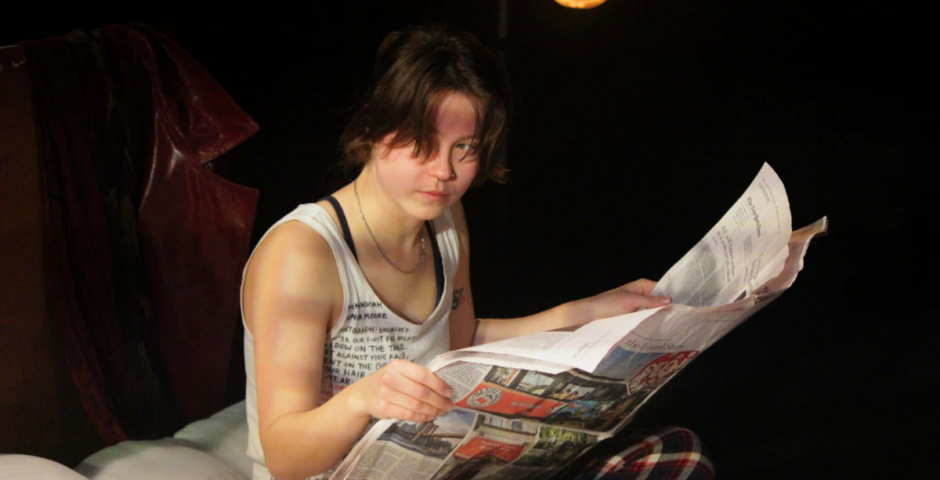
To Flossie Adrian’s Beautiful, a name means everything. Words mean everything. Leafing through the New York Times, they see letters and words – eventually whole identities – being removed from national databases and records and it fills them with dread. To H Sneyd’s Darling – occasionally Dipshit – things don’t seem to matter.
They satirise Beautiful’s dread turning it into a game of word play and leaping into sexual innuendo any chance they can get. Darling finds Beautiful’s seriousness agitating, and Beautiful finds Darling’s insouciance grating. And yet neither can leave the other- they’re linked by a desire not to leave their absent third bed mate, and eventually- not to leave each other.

via Luke Quentin
The characters call this “Slutty purgatory”, and I could not help but recall Sartre’s existentialist No Exit in which three characters are trapped in a hotel room in Hell to torture each other. Except the conceits in Sartre’s play are fiction, and his characters unsympathetic. Crowley embeds real life news stories as catalysts for conversation between the two characters and it is harrowing to see the erasure of their identity before our own eyes.
Crowley avoid letting either character fall into clichés through sharp dialogue which can shift between side splittingly funny and heart achingly morose in a matter of seconds. Such dialogue serves not just to entertain but to deconstruct the walls the two protagonists have put up.
Darling and Beautiful are wrapped up in a web of lies, some to eachother and some to themselves. Darling seems happy to let them be, whilst Beautiful undertakes their unrevelling. This push and pull through sex and dialogue climaxes in a disagreement as to what their bodies mean to them. “This body is political”. Beautiful declares taking off their shirt, not triumphantly, but with resignation. They feel an obligation to care and, in their strength to speak out is their vulnerability.
Adrian plays Beautiful with such nuance that in only the slightest twitch of their mouth, they can shift the tone of the play. It is a masterclass in subtlety that serves writing steeped in subtext.
Beautiful constantly searches for clarity and labels because they want to belong, and their obsession with the crossword, a succinct word to condense an abstract idea is telling of this. Beautiful is the audiences’ entry point into the world of the characters, walking us through their concepts and ideas with an urgent kindness and enthusiasm that never condescends.

via Luke Quentin
Sneyd’s Darling is the complete opposite. Charming, charismatic, and dirty, the character could easily be written off as a pastiche. But once again through Crowley’s writing and Sneyd’s tour de force performance something quite profound emerges. Darling is a reactionary character who feeds off the energy of others, and Crowley constantly forces them to confront their own solitude. It is in these moments that Sneyd truly shines.

A key moment falls towards the final moments of the play when Sneyd is left truly alone, and we realise how much the topics they dismissed earlier mean to them. If Adrian plays the anchor that grounds us and the play in reality, Sneyd’s character is the titanic, a beautiful, proud performance that we love but can’t help but feel is slowly starting to sink.
Crowley approaches the topic of gender identity and what it means to be labelled with a deep sensitivity. The play is steeped in Christian allegory in a way which feels thematically resonant. Elements of resurrection emerge throughout the play, firstly in humorous wordplay of the ‘second coming’, but ultimately in Darling’s feeling of elation about being able to live their life again in their newfound identity comparing themselves to Jesus being wrenched off the cross.

via Luke Quentin
The play’s final monologue regarding Darling’s experience in both male and female bathrooms never comes across as preachy but rather pertinent. Crowley is careful never to let their characters become personifications of a specific idea or movement but rather allows them room to breathe through distinct characterisation, interests and quirks, many unsaid but shown through action. It is a masterclass in the direction of the unspoken.
Beautiful and Darling’s gender identity is important but as the latter proclaims ‘it’s not the only interesting thing’ about them.
Crowley isn’t trying to sell a political message but a deeply personal one, imploring us to engage with our humanity by asking us what it truly means to be human.
[Rib]Cage is the most important piece of art I have seen this year thusfar. It is a play that asks the same questions many institutions and individuals are right now, what does identity mean. And in its answer Crowley isn’t trying to sell a political message but a deeply personal one by asking us what it truly means to be human and who has the power to decide that.
[Rib]Cage runs till Feb 21st at Queen’s Black box.
For more of the latest news, guides, gossip and memes, follow The Cambridge Tab on Instagram, TikTok, and Facebook.
Featured image via Luke Quentin


Latest
Influencer apologises after backlash over ‘grossly inappropriate’ Lindsay Clancy post

‘Why do you feel comfortable getting paid off the back of a tragedy?’

The ‘homophobic’ drama surrounding this notorious OnlyFans lad… who makes p*rn for gay men

He’s been banned from TikTok now, but each video he’s posted has made it SO MUCH WORSE

Where the cast of The Inbetweeners are now 12 years on, as Netflix announces third film

Jay, Simon, Will and Neil are all coming back
JP Miller’s dad has a 40-year criminal history, including dark allegations made against them both
Accusations against Reginald Wayne Miller are over a 40 year period

A key witness in the Mica Miller case tragically died not long after she was found

Johnnie Jacobs was at the scene when Mica died
The UK universities which spent the most money on ‘restructuring’ and cutting staff’s jobs

Several Russell Group unis spent millions on voluntary severance schemes

The three Love Island 2026 cast members who brutally weren’t invited to the NTAs
Two of them are finalists
The KATSEYE tour drama explained, from ticket chaos to backlash over their young fans

There’s been a LOT going on
Bonnie Blue seemingly banned from Insta after these new videos featuring newborn with masked men
It looks like these videos have resulted in her second Instagram ban

The reason Gemma Owen secretly split from her millionaire property heir boyfriend, Red
‘We just came to a bit of a crossroads’
These are the most controversial things JK Rowling has ever said, as Harry Potter returns
It’s really, REALLY bad
Priya and Aidan both share statements confirming sad reason they split after Love Island
This is such a shame!
The full 17-minute 911 call Mica Miller and her sister made when JP said he was ‘armed and ready’
Mica and her sister placed the panicked call when JP Miller said he was coming to get her
Cruise drama explained as ‘petty icon’ pulls off elaborate sting operation to confront friend
She used a ‘hook-up’ app to find him on the cruise she was supposed to be on

Co-workers who duct taped American Airlines passenger to plane seat reveal what it was like
They were on their way back from a work trip and had to step in

JP Miller’s case update after Death of the Pastor’s Wife, as he’s due in court next month
His federal case has moved forward

Ranked: The best Too Good To Go surprise bags to collect near UCL campus

We tried the most popular locations so you can get the best bang for your buck