

Newcastle medical students to take part in ‘Stop the Drop’ campaign today
The national BMA-backed campaign calls for full maintenance funding throughout medical degrees

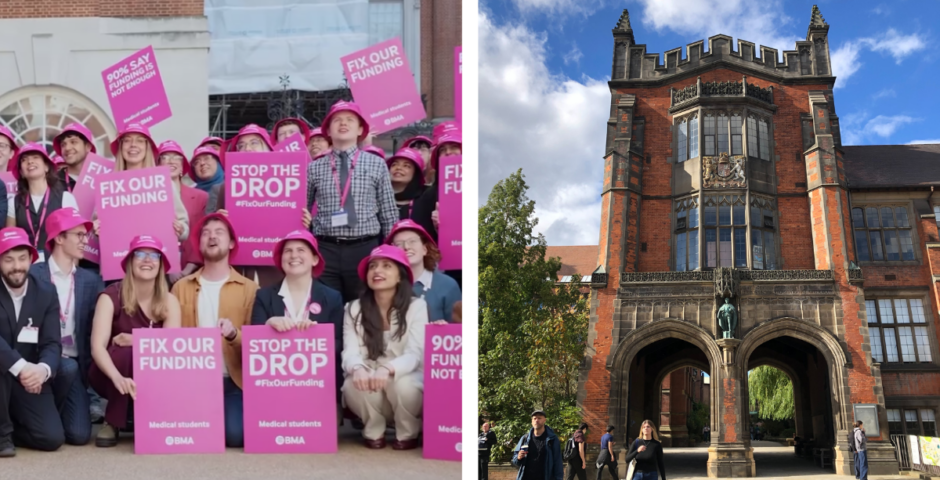
Newcastle students will join medical students across the country today to take part in a British Medical Association (BMA)-backed campaign calling on the government to provide full maintenance funding for the entire length of medical degrees.
The campaign, branded “Stop the Drop” and led by the BMA Medical Student Committee, will take place across 10 university campuses in England, including Newcastle. This coincides with the release of a new report highlighting the financial pressures faced by medical students.
“Fix our Funding” forum events will bring the issue directly onto campus through student-led events aimed at raising awareness of how funding gaps are affecting student wellbeing, education, and future careers.
According to the BMA, in the 2025/26 academic year some students transitioning onto the NHS bursary will experience a drop in annual funding of more than £4,500, leaving many struggling to cover basic living costs.
Unlike most undergraduate courses, medical degrees last five or six years. While students receive standard Student Finance maintenance loans in the early years of their degree, support is significantly reduced in later years when they move onto a lower-rate loan alongside a much smaller NHS Bursary.
In the report, a BMA survey of more than 3,500 medical students found that over 100 students relied on food banks to get by.
Lily*, a second year medical student at Newcastle, said: “I don’t know how we are expected to do a full-time placement when we can’t even afford a full food shop. I think we should be paid for placement like other courses are, especially because we are training to save lives.”
Yalna Pouya, deputy co-chair for finance on the BMA Medical Student Committee, said: “Too many students are struggling to afford the basics while they’re studying hard to become the doctors of the future.
“They’re burning out trying to work multiple jobs to keep afloat, and in too many cases questioning whether they can continue training as doctors at all. The NHS can’t afford to lose them.”
Fellow co-chair Anusha Gajanan said: “This awareness day is not about confrontation. It’s about education and unity. By bringing the campaign onto campus, students can show just how widespread and serious this issue has become, and why the Government needs to pay attention and act.



“Making sure medical students receive full maintenance funding for the entirety of their studies is a small change that would make a real difference, for students and for the sustainability and diversity of the future NHS workforce.”
The BMA estimates restoring full maintenance funding across all years of medical degrees would cost the Treasury £29 million, equivalent to just 0.147 per cent of Student Finance England’s annual lending.
The association warns that failing to address the funding gap risks driving students, particularly those from less privileged backgrounds, out of medicine at a particularly stressful time for the NHS.
A Newcastle University spokesperson said: “The national funding available to medical students in the later years of their degrees is both unfair and inadequate. It means many of our students are living in very difficult circumstances.
“While we are able to support students in serious financial hardship, we know the majority of our students are impacted by this shortfall in funding, to the detriment of their studies.
“We have campaigned for a long time for a fair funding system to enable medical students in the later stages of our programme to flourish.”
Newcastle University is among the universities the BMA wants to hear from. Medical students impacted by inadequate funding can get in touch here.
*Pseudonym used for anonymity.
Featured image via Instagram @bma.students

Latest

More than two tonnes of plastic pellets may remain in the Tyne, researchers warn

A collision in July released around 17 tonnes of nurdles

Jax speaks out after toe-curling Love Is Blind reveal, and shares why she *really* ghosted Stew

She claims it had nothing to do with his appearance

A full record of how The Celebrity Traitors S2 cast voted at each Round Table session

Yup, we’re keeping track of all the stats

The Celebrity Traitors comedians whose fortunes are no laughing matter, from £1m to £6.5m

The fact Miranda isn’t the highest is criminal

Celebrity Traitors’ King Kenny was arrested after filming a prank on his university campus

He has a wild backstory from his YouTube career
Is this the downfall of Turnitin? Here’s what you need to know

Turnitin’s system is changing and students’ data could be used to train tools which use Artificial Intelligence

Fewer apps, more life: My experience at the launch of the social SuperApp ZYMIX

Inside the launch of the SuperApp that wants to clear out your home screen
The question we’re all thinking about: What exactly is happening with the library?

Everything you need to know about the JB Morrell Library refurbishment

Plans submitted to council for new research facility at York University

University of York’s Campus West could see a new research building after plans submitted to York Council

Wait, why was Barack Obama in Manchester city centre?

The former US President was spotted outside a hotel before speaking at Co-op Live

The Celebrity Traitors producers are already eyeing up big names for season three’s cast
Stephen Lambert wants Tom Cruise and ‘a big sports star’

Hannah Fry has crunched the numbers, and spotted a suspicious Celebrity Traitors voting pattern
It could be bad news for the Traitors

Former Lancaster University professor John Whitehead dies aged 76

John was a lecturer of mathematics and statistics

How to avoid the struggles that come with a part-time job at a Bristol university

After all, we do live in on of the most expensive cities in the UK.

All the public scandals The Celebrity Traitors cast have been in, from arrests to racist tweets
They’re not as wholesome as people think
Newcastle and Northumbria universities join forces for new Student Health Hub

Students of both unis can access the mental health service on Friday mornings

The net worths of the American Horror Story 13 cast prove who desperately needed that pay cheque
A $50 million net worth with two minutes of screentime? Nice

Three UK universities announced language course closures in 2026 – including Edinburgh
The University of Edinburgh is scrapping 90 programmes

‘She is phenomenal’: Traitor Hannah Fry has realised that she’s related to her co-star
‘I cannot tell you how much I admire her’

From Crawford to Turing: the stories behind UoM’s building names

You’ve walked past them loads, but how many names do you truly know?