
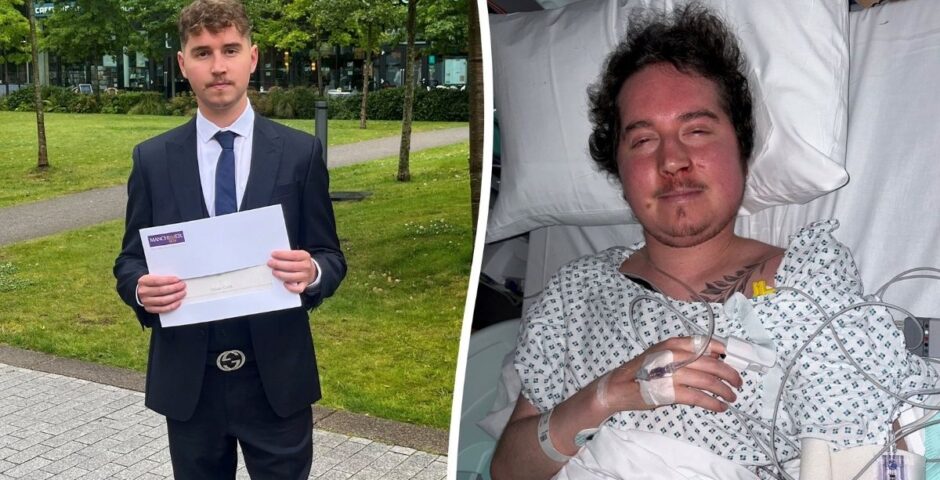
Uni of Manchester graduate diagnosed with tumour after mistaking symptoms for exam stress
Ollie Cook had ‘given up hope in the healthcare system’

A University of Manchester graduate was diagnosed with a tumour after blaming his fatigue and brain fog on exam stress.
Ollie Cook noticed muscle loss and began feeling unwell during his final year studying law.
Doctors discovered a pituitary tumour, which was removed in a successful surgery 18 months after initially feeling unwell.

via SWNS
Ollie, from Sleaford, Lincolnshire, initially attributed his fatigue, brain fog, and muscle loss to academic stress. Despite feeling unwell, he was otherwise healthy and dismissed his symptoms.
After a four-month trip around Southeast Asia, his condition persisted, but doctors could not find anything wrong and recommended physio exercises.
As his symptoms worsened, Ollie noticed persistent muscle pain and the inability to gain muscle despite training. After returning from his travels in December 2023, he visited his GP, but the general symptoms led to no clear diagnosis. He was given physio exercises and sent home, but Ollie knew something wasn’t right.
Ollie travelled to Kenya in early 2025 for a law internship, but his health continued to decline. When he returned to the UK in June, he collapsed again from an aneurysm and was rushed to Lincoln Hospital, where doctors identified the tumour.


via SWNS
18 months after his initial consultation, doctors discovered a pituitary tumour—a growth in the pituitary gland, located near the brain. Ollie was transferred to Sheffield Hospital, where surgeons successfully removed the tumour and part of his pituitary gland. He now takes hormone replacement therapy, painkillers, and blood thinners, and has regular MRI scans to monitor for any recurrence.
“I was relieved to finally have an answer,” Ollie said. “After months of uncertainty, it felt like a weight had been lifted, even though the diagnosis was serious.”
Ollie’s experience highlights the importance of listening to your body, even when symptoms seem unclear. For months, Ollie’s symptoms were too vague for doctors to pinpoint a cause, but eventually, the tumour was discovered, and surgery led to a positive outcome.
Shannon Winslade, Head of Services at The Brain Tumour Charity, said, “Ollie’s story underscores how vital it is to raise awareness about brain tumours. Early detection can make all the difference, and it’s important to know that no one is alone in their journey.”
Now recovering, Ollie remains proactive with his health, including regular check-ups, and hopes his experience will encourage others to trust their instincts and seek help if something feels wrong.
Featured image via SWNS
Latest
First week back at uni? Here’s everything you need to pack in your bag

Mary Poppins is quaking in her boots…

London university releases statement after professor sentenced for a child sexual offence

Barry Langford was a Professor of Film Studies at Royal Holloway


Young father-of-two died on day he was due to start at University of Glasgow

Young father tragically passes away at 24 years old after suffering a brain aneurysm
Bella Ramsey’s specific acting career gives them ‘an edge’ on Celebrity Traitors (they hope)
Their past roles have prepped them for Missions
12 of The Celebrity Traitors season two cast asked to be Traitors, and six to be Faithfuls
Three celebs couldn’t make up their minds
Maya Jama’s game plan for Celebrity Traitors is to avoid trying ‘too hard’ or ‘overthinking’
This is really devious tbh

Newcastle University buildings evacuated after ‘suspicious item’ found on campus

Police, fire crews, and fire engines arrived at the scene
12 things every Fresher gets wrong in their first few weeks at uni

From wearing your lanyard everywhere to leaving your washing-up until it grows its own ecosystem
Our Celebrity Traitors predictions include Maya Jama turning on her fellow Traitors

Here’s what we think will happen
I’ve just realised that three cast members from Celebrity Traitors were in Game of Thrones

Having flashbacks to Bella Ramsey being crushed by a giant



23 to 70: The ages of the Celebrity Traitors 2026 cast, from youngest to oldest

There’s a huge age range this year
James Blunt was a British Army captain before becoming a singer and joining Celebrity Traitors
He mentioned it on the show

Monster director finally admits why they forced Aileen Wuornos in a show about Lizzie Borden
Despite the name, Lizzie Borden is not the focus of the story
Shows and films you can watch about Aileen Wuornos, where she isn’t thrown into another story

Others tell her entire case, unlike Monster on Netflix

This viral tool lets you customise your Apple Pay cards, and here’s how to do it
You can personalise the entire design

James Acaster could be the Celebrity Traitors’ recruit, as filming reportedly paused for him
It’s not much of a cliffhanger

The ridiculous fortunes of The Celebrity Traitors: Their net worths, from £500K to £50 million
One of them could legit buy the castle three times over