Students at King’s College London sign open letter against recent examination proposals
A 28-page document released by the university details major changes to the examination process

Students at King’s College London (KCL) have signed an open letter against recent examination proposals set out by the university in a 28-page document.
The Transforming Assessment for Students at King’s (TASK) project is going into its second year of implementation at KCL, and it aims to overhaul and improve the assessment experience for both students and staff, especially with the rise of generative AI.
However, the university’s recent publication of the 2025-26 update has been met with considerable backlash, particularly from students who wish to progress from undergraduate to postgraduate education.
Some undergraduate students have criticised the recent proposals, saying they do not feel that “the reduced assessments provide sufficient preparation for postgraduate study.”
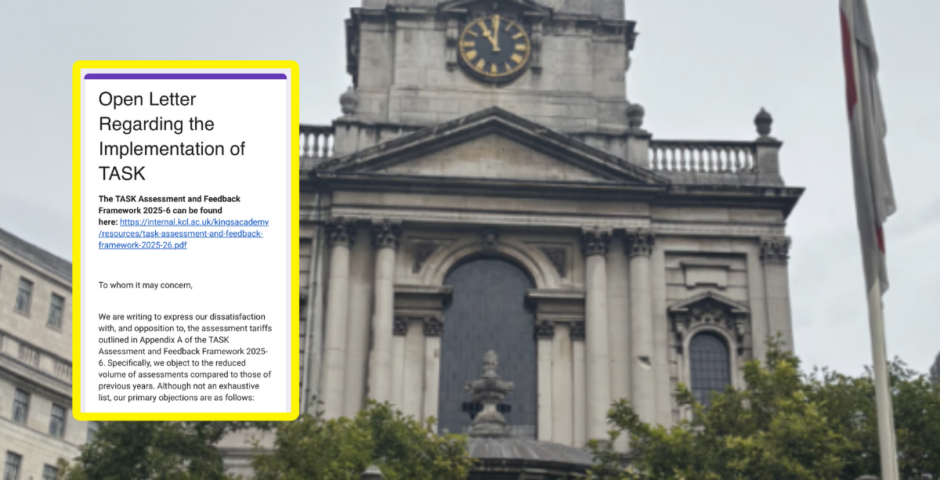
In response, an open letter “regarding the implementation of TASK” has been circulating among students, which expresses dissatisfaction with Appendix A in the TASK publication.
Appendix A details the changes that are underway to examination procedures. One of the most unpopular changes is the reduction of 50 per cent of coursework assignments to a 1,300-word count cap. For coursework assignments worth 40 per cent, essays will be capped at 1,200 words, and assignments worth 30 per cent will be capped at 1,000 words.
Another point in the document that has been met with contention is that the university must “reduce complexity in terms of the number of optional modules” as “there is a balance to be struck between desirable choice for students and a limited number of curated pathways through a programme where the programme-level view is not lost.”
The open letter, however, does not refute this point and largely focuses on the word count restrictions.
This letter also lists a number of primary objections, which include the inability to compete effectively with peers in future endeavours, the inability to engage as meaningfully with studied subjects of interest, and the lack of reduction in academic stresses, as the letter argues that “although the task of writing long-form essays is stressful, so too is the process of editing a project down to hit a word or page count”.




via Unsplash
The open letter concludes: “Although we support many of the principles of TASK, we do not feel that the proposed reduction of assessments is of any benefit to students.”
Professor Adam Fagan, vice president KCL, told The King’s Tab that TASK has been developed in direct response to feedback from students and staff, devising a framework that draws on sector-wide best practice and that will demonstrate a greater range of skills and knowledge through assessments.
A student at King’s College London told The King’s Tab that a reduction in optional modules curbs one’s ability to work out where their academic interests lie.
“I think that reducing the amount of optional modules significantly decreases our freedom with what we are able to specialise in as optional modules play an essential role in allowing students to shape their degree around their strengths and interests”, they said.
The student continued: “Decreasing the amount of words is already an issue for us students as we are already constrained with how much we can write as footnotes contribute to our final word count, and these new rules will only make essays even shorter as there will be less space for us to fully develop our arguments.”
Professor Adam Fagan, vice president (Education & Student Success) at KCL, said: “The ‘Transforming Assessment for Students at King’s’ (TASK) initiative has been developed in direct response to feedback from students and staff about the way coursework is assessed at King’s.
“Drawing on sector-wide best practice and a thorough consultation process, which is still ongoing, with student representatives and advisors, KCLSU, and Faculty staff throughout 2024 and 2025, we have created a framework designed to develop and demonstrate a wider range of skills and knowledge through assessments for students and staff.
“This framework sets out clear principles for good assessment and feedback, embedding consistency across programmes at King’s to support student excellence.”
Latest
Er, Lizzie Borden’s meeting with the actor Nance O’Neil was nothing like Netflix’s Monster

Their paths didn’t actually cross for another 14 years
With 600 alleged killings, this minor character in Lizzie Borden should have been the Monster

HUGE missed opportunity

Did Andrew Borden have a stutter? Charlie Hunnam breaks down accent and voice in Netflix show

The actor has fully explained it

Elektrik Warehouse responds to alleged ‘crowd crush’ concerns at Shoshi event

‘It was just lucky nothing insanely bad happened’
Uni of Edinburgh confirms 25 days of strike action over five weeks, affecting Welcome Week

Am email sent to Edinburgh University students read ‘staff are not obliged to tell us if they plan to take part, which means we cannot tell you who is or is not’

There’s a really smart way to hack your Spotify Wrapped results for 2026 – before it’s too late
The cut-off for data tracking is very soon!

Meet OnlyFans’ gay ‘golden boy’ Ashton, and the thirsty clip that’s earned him 33 MILLION views
The clip is seconds long, but it leaves an impression

Real-life significance of Lizzie Borden’s period and if she suffered from menstrual problems

It’s a big part of Monster: The Lizzie Borden Story

My straight boyfriend does gay OnlyFans, but I’m scared he’ll leave over one thing he keeps saying
He replied, ‘It’s always been my rule since day one: If the cameras are on, it’s not gay’

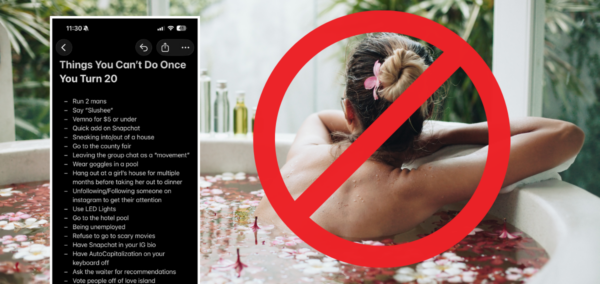
This viral list ‘years in the making’ claims these 21 things are FORBIDDEN once you turn 20
If you do any of these you should reevaluate your life, apparently

Woman whose Love Is Blind partner tried to kill her says he still contacts her from prison
He was sentenced to 15 years

Why Ed Sheeran is ‘furious’ as details emerge about the 40-minute call that got Macklemore fired
‘He’s been thrown under a bus’

Miley Cyrus reveals her emotional final conversation with Dolly Parton before she died
‘That’s what made us so perfect’
Nick Mohammed to appear in Traitors West End production

The influence of Durham’s student theatre scene
Three universities rank higher than Oxbridge in The Times’s league tables for 2027
The new top university in the UK isn’t part of the Russell Group
Inside the vibey life of Lizzie Borden actress Ella Beatty, who has two very famous parents
I’m sorry, dating rumours with Hugh Jackman?

So, that nursery rhyme about Lizzie Borden is almost completely factually incorrect
I can’t believe children actually sing it
What to wear for lectures when you go to uni in the North

Despite the weather warnings, signs may suggest your 9am is still manageable