

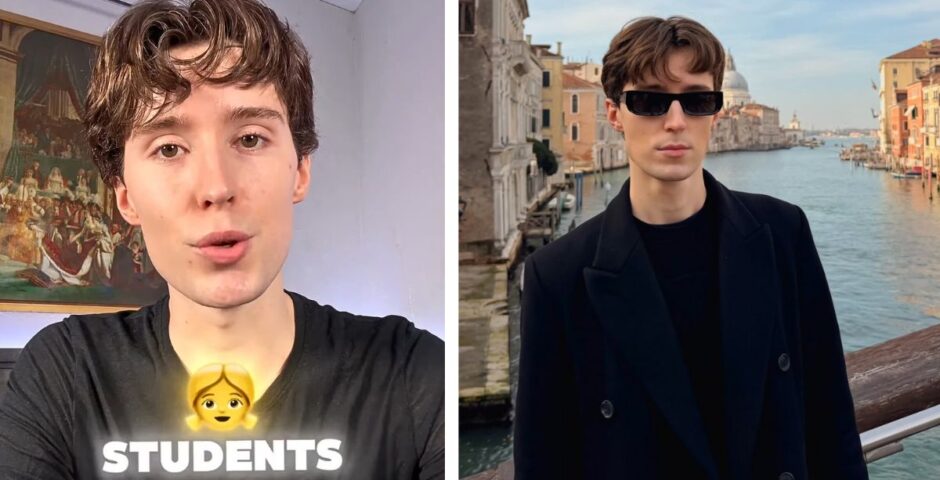
Interview: Jack Anderton on universities, Harry Styles tickets and why he supports Farage
Cambridge University Labour Club members protested outside the venue during Jack’s appearance

Cambridge University Labour Club did not mince words about Jack Anderton’s arrival. In their statement condemning the invitation, they wrote: “We are disgusted that the Cambridge University Conservative Association has invited figures with a documented history of racism and far-right ideology to our university.”
It claimed Jack has “no place on campus” and that “it is not free speech to give succour to far-right extremists.”
This was the atmosphere in Cambridge into which Anderton walked at midday, accompanied by Noah—his tour manager, organiser, and Durham history student—to give an interview with me at King’s ahead of his evening appearance.
Anderton arrived dressed in black jeans, an oversized blazer, and a long white T-shirt, an outfit that was, in my humble opinion, the uniform of a certain subset of a mid-twenties man with any kind of strong political affiliation.
He seemed to have one foot in politics and one foot in lifestyle content, with both feet firmly planted in the belief that being correct is partly a matter of aesthetics. (When asked how he would describe this personal aesthetic later, Jack would just say “Dark”).
It is not hard to believe that The Dark Knight is one of his favourite films, Anderton’s own event posters bear an uncanny resemblance to Batman looking broodingly over Gotham.
The interview was observed not only by me, but by one visibly horrified member of the King’s E-Lab, who did not seem to get much work done while listening and watching intently. Curtain bangs, never fear, it’s all here for you to read, though we all appreciated your evidently keen interest.
“Every student that I’ve spoken to agrees and recognises that something is fundamentally wrong with the country”
View this post on Instagram
Anderton grew up just outside Liverpool and described his childhood as “very, very nice” and “pretty normal.” His politics, he said, were shaped not by family but by events: “I would say I was more shaped by the Brexit referendum and the election of President Trump… when I was 15 and 16. And they were formative events, really, for me.”
King’s College London, meanwhile, did not inspire fondness. He said he “did not enjoy it” and described “university in general” as “a waste of time”.
He was careful to qualify that he was “not the sort of right winger that’s like, ‘Don’t go to university kids,’” explaining that “the system we have now is very credentialised, and you need a degree,” even if “you get it from the state for about three years, and then you’ve got to pay it back.”
What universities did provide, in his view, was confirmation of national decline, adding that “every student that I’ve spoken to agrees and recognises that something is fundamentally wrong with the country … and that they’re not happy with our current path.”
The disagreement, he insisted, was merely about solutions: “The debate is the path that we take to […] reverse the direction.”
“I care about our island, and that’s pretty much it”
Much of the opposition to Anderton’s appearance centres on claims that he wants Britain to reclaim its former colonies. Anderton was categorical. “I did not express that,” he said, “I did not say that.”
His actual position, he insisted, was that he is “very much focused on our current land. I care about our island, and that’s pretty much it.” If, say, Australia wanted to rejoin Britain, he added, “great,” but he very much doubted it would.
So where did the claim come from? From his blog post, he explained, which was “talking about a sort of alternative future.” In that post, Anderton argued that had Britain not fought in the First and Second World Wars, it might have avoided bankruptcy and instead developed its empire, holding onto countries like India, Canada, Australia and South Africa.
One can only wonder whether CULC will be reassured to learn that Anderton does not, in fact, intend to reclaim the colonies, and will be mollified by the knowledge that he merely imagines a parallel universe in which Britain never fought the Second World War and developed and retained the colonies instead.
I raised the widespread claim going around Cambridge that Anderton didn’t think Britain should have fought in WW2 at all. “Again, I did not say that,” he replied, before supplying his opinion: “Britain was bankrupt after fighting both world wars […] Of course we should have fought the Second World War, and of course, we should have defended Europe.”
What was up for debate, in Anderton’s view, was the cost. His argument, he said, was not moral but economic; the wars, he argued, left Britain impoverished, dependent, and structurally weakened in a way that other nations were not. Anderton seemed most frustrated in the interview at the colonies and world war questions, claiming it was due to the fact that “most people don’t read and can’t understand context.”
The New Dawn Tour: “I really just decided I was gonna go for it”
View this post on Instagram
When asked about the tour itself, Anderton traced its origin to political violence elsewhere and to American inspiration. He said the tour “really sort of kicked off after Charlie Kirk was assassinated,” adding that he’d wanted to speak to students for a while, and that he was influenced by “Turning Point USA and their tours across American universities.” After the assassination, he said, “I really just decided that I was gonna go for it. Sort of now or never.”
Why “New Dawn”? Because, he argued, “Britain is headed in a wrong direction,” and “there is a new dawn on the horizon. It’s just whoever takes that and runs with it.” His list of goals followed: “Lower immigration. Cheaper energy, meritocracy, more job opportunities, more housing […] an abundance, and a richer […] greater country.”
“If we can’t enforce our own borders, then what is the point of the state?”
Immigration was the gravitational centre of Anderton’s politics and, by his own admission, “the main topic that has been discussed” on the tour. He framed his case economically: “If you’re letting a million people into the country, and you’re only building 200,000 homes[…] the cost of housing is gonna skyrocket.” He also talked about “integration” and “assimilation,” describing the British state as doing “quite poor” at it.
On illegal immigration, his language sharpened further. He argued people are angry about “tens of thousands, hundreds of thousands[…] who have crossed into our country illegally, and have been given hotels, have been given food… essentially had their life paid for,” framing it as “a question of fairness.” His conclusion was absolute: “If we can’t enforce our own borders, then what is the point of the state?”
“If you are here illegally, you are a criminal and you must be deported”
When asked about deportation, he said: “If you’re here in Britain illegally, you should be deported.” When asked about his views on more complex cases, he claimed it all “depends on your legal status” — and insisted, “I’m not an advocate of a cruel policy,” adding that some situations are “case by case”.

When I raised the suggestion that the British economy relies on immigration, and would collapse overnight without it, Anderton rejected this completely, laughing, and pivoted to technology: Britain, he argued, is “built with sort of cheap labour,” and because “it’s actually cheaper to employ a low wage migrant[…] than it is to invest in, say, a robot”.
He said Britain has fallen behind on “automation” and “robotics” and that immigration has “kept us behind. It’s kept us in the past.”
Quick-fire questions
Pressed into a rapid-fire game of kiss, marry, kill with Kemi Badenoch, Keir Starmer, and Nigel Farage, Anderton answered with the same confidence. “Obviously, marry Farage,” he said, before adding that he would “probably kiss Kemi” and “kill Keir.” The phrasing was emphatic.
When asked whether Harry Styles’ ticket prices were directly impacted by the Labour budget, Anderton paused. “I don’t even know how,” he said, before concluding, “probably, sure. Yeah. Let’s say yes. Why not?”
When asked to summarise his vision for Britain, Anderton offered something closer to a slogan than a policy programme. “I want people to be wealthy,” he said. “I want people to be happy. And I want people to be able to follow the path that they want.”
When pressed for his hope for Britain in one sentence, he answered almost immediately: “Prosperity, wealth, and success.”
When explaining why he believed Nigel Farage was “the man for the job” of Prime Minister, Anderton framed leadership as a question of vision and appearance.
“Reform has a leader that you can envision being the leader of our country,” he argued, contrasting this with his assessment of other party leaders.
“If you look at Keir Starmer,” he said one sees a, “you know, a used car salesman. If you look at Kemi Badenoch, well, I wouldn’t want to even say what she looks like.”
Jack’s reaction to CULC members protesting the event
View this post on Instagram
Later on, when attending Jack’s evening event, I ran into CULC’s protestors outside the venue. A small but committed protest gathered, determined to make its opposition audible even if it was not always precise.
A spokesperson for the protesters denounced the speaker as “Jake Anderton”, a very noticeable slip that went uncorrected as they went on to explain that they would not “stand by whilst someone who is a racist” was allowed to speak at Cambridge.
The objection, they said, was rooted not just in Anderton’s views on immigration, but in what they described as his belief that Britain “should reclaim the colonies” and “didn’t believe we should have fought in the Second World War”, two claims Anderton himself had repeatedly denied earlier that day.
The chants were more confident than the details. “Let in every refugee,” the megaphone called out, “throw the Tories in the sea,” a slogan that managed to be both expansive in its generosity and selective in its targets.
Jack, however, did not seem phased by the protesters. In the evening, he would later dismiss the protest as “pretty feeble[…] just about 15 people calling me a racist.”
His explanation for why people protest him also returned to his favourite theme. “I don’t think they’ve even listened or read about what I believe. They read a headline and then don’t actually get into the context.”
He claimed there is a “crossover” between his issues and theirs, and said he’d left a comment on the CULC Instagram inviting critics to attend: “When you listen to me speak, I think, actually, you will see that there is some crossover with the issues that they have and the issues that I have with the country.”
A Cambridge University Labour Club spokesperson said: “Jack Anderton can imagine as many parallel universes where Britain never fought in WW2 and instead developed its colonies as he likes. In the real world, where CUCA had to cancel an invitation to a controversial speaker just last week (still no resignation), CULC will continue to speak out against Reform in Cambridge.”
The New Dawn aesthetic
Once inside, shortly before proceedings began at Jack’s evening CUCA event (attended by an eclectic mix including the head of Reform for Cambridge city council, the president of CUSW, and a previous Reform MP candidate) Noah, Jack’s tour manager, was heard politely asking attendees to shift their position. “Would you mind moving further down?” he asked. “It’s for the aesthetic.”
At least on that point, Jack Anderton’s vision was easy to understand.
A Cambridge University Conservative Society spokesperson said: “CUCA invited Jack (not Jake) as he is an important, young advisor for Britain’s most popular political party (according to the past ~10 months of polling data). His voice and views are relevant to the political discourse of Britain, in particular young people.
“Despite the attempt at disruption, the event went ahead peacefully and with civility. Attendees who disagreed with Anderton were given plenty chance at the event Q&A to hold Anderton to question and debate him in a constructive way.
“It is a pity that rather than being able to engage with him maturely, as Anderton himself hoped for, some decided instead to protest and attempted to get the event cancelled.
“CUCA remains committed to freedom of speech within the boundaries of the law. We are happy that the event went ahead as planned, and would like to thank the university and campus security for helping us host Anderton and defending free speech on campus.”
Cambridge University Labour Club, the UK government and the Conservative party have been contacted for comment.
For more of the latest news, guides, gossip and memes, follow The Cambridge Tab on Instagram, TikTok, and Facebook.
Featured image via Instagram @jackguyanderton
Latest

There are co-star dating rumours about A Different World’s fittest star, Cornell Young IV

There’s gonna be about a million disappointed people

Hannah Fry revealed her plan to stay ‘mischievous’ during Celebrity Traitors season two

‘I’m toxically competitive’
Where Miranda Hart has been as she returns to TV on Traitors, from health issues to new husband

It’s such fun to have her back on our screens
Where the brainy Celebrity Traitors cast went to university, plus what they studied

Of course loads went to Russell Group universities
Lizzie Borden never married, despite speculation about her relationship with Nance O’Neil
Netflix explored her relationships with women



As Christa Pike’s execution fails, her accomplice boyfriend is living a totally different life
He gave an interview from prison in 2026

Christa Pike is one of eight people in US history to survive execution by lethal injection
She is being treated in hospital

When will Georgia Toffolo realise no matter how many times she pretends to be relatable… she’s not?

She’s posted yet another video about money

Meet Moyin Odeniran, the KCL student taking part in this year’s Great British Bake Off

Turns out all those hours in the library were worth it
Witnesses describe Christa Pike’s failed execution after she survives two rounds of lethal injection
‘I’ve witnessed, I believe, five executions in Tennessee. Nothing about today was normal’

A timeline of how Christa Pike’s failed lethal injection attempt unfolded, and where we are now
A lot has happened since 10am yesterday

How to add any physical loyalty card to your Apple Wallet with genius new iOS 27 feature
Finally something that’s actually useful

Prue Leith admitted being 86 was one reason she decided to leave The Great British Bake Off
She has been replaced with Nigella
Louis Theroux subject fined after cornering shop worker with comments about his ‘English wood’
She felt ‘trapped’ as five men surrounded her
11 UK universities rank among the top 100 in the world – but not Durham
The University of Oxford is still first in the world

Christa Pike’s failed execution is Tennessee’s second this year, after Tony Carruthers
He has been granted a one-year delay

Pete Davidson shares his opinion on the constant body image scrutiny ex Ariana Grande gets
‘I don’t like it at all’

‘She didn’t die’: Mum of Christa Pike’s victim speaks out after two failed lethal injections
She said Christa showed no remorse

Christa Pike’s lawyers share statement addressing why death row inmate’s execution failed
A comprehensive review will ‘determine exactly what occurred’