
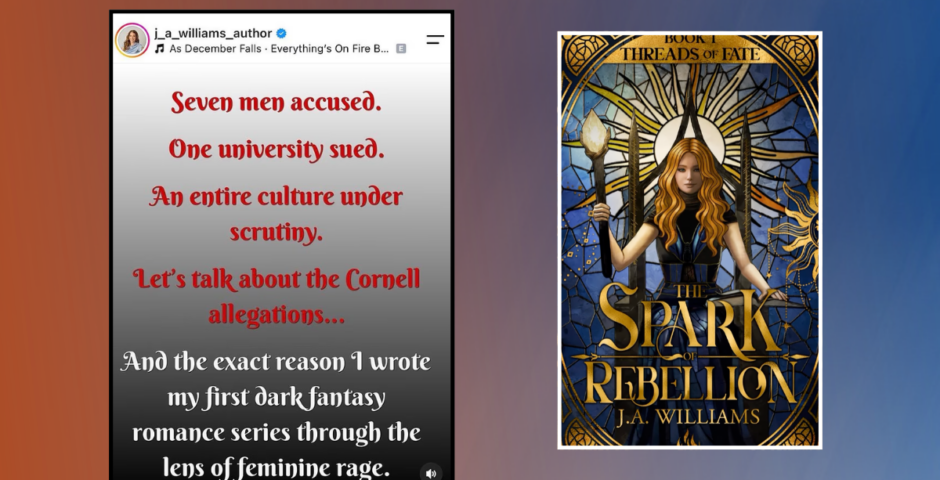
Author responds to backlash after using Cornell case to ‘promote’ her steamy dark fantasy book
‘Seven men accused. One university sued. An entire culture under scrutiny’
An author of adult fantasy books has been forced to defend herself after what many people viewed as her “promoting” her upcoming novel using the Cornell case.
*This article contains details that may be upsetting*
The alleged rape at Cornell is said to have happened in 2024, but people are now talking about it after Jane Doe filed a civil lawsuit against the University and the men widely referred to as the “Cornell Seven.” She claims to have been raped for hours in an incident involving alcohol and ketamine.
Vile group chat messages quickly surfaced online, and they showed Jane Doe being referred to as a “shop” other students could use. New York state prosecutors have now reopened the case.
Amid that, people argued that author Jessica Williams used the story to “promote” her upcoming series. Here’s the full picture:
Jessica Williams has since deleted this Cornell post
In October, Jessica Williams is set to launch a new five-book series called Threads of Fate, with the first instalment called The Spark of Rebellion.
On Instagram, she posted a lengthy statement that started with: “Seven men accused. One university sued. An entire culture under scrutiny. Let’s talk about the Cornell allegations… And the exact reason I wrote my first dark fantasy romance series through the lens of feminine rage.”
Set to Everything’s On Fire But I’m Fine by As December Falls, the post continued to outline the Cornell story: The allegations, the group chat messages, statistics on campus sexual assaults, her own unrelated experiences with the Greek system, and the complicity of other men.
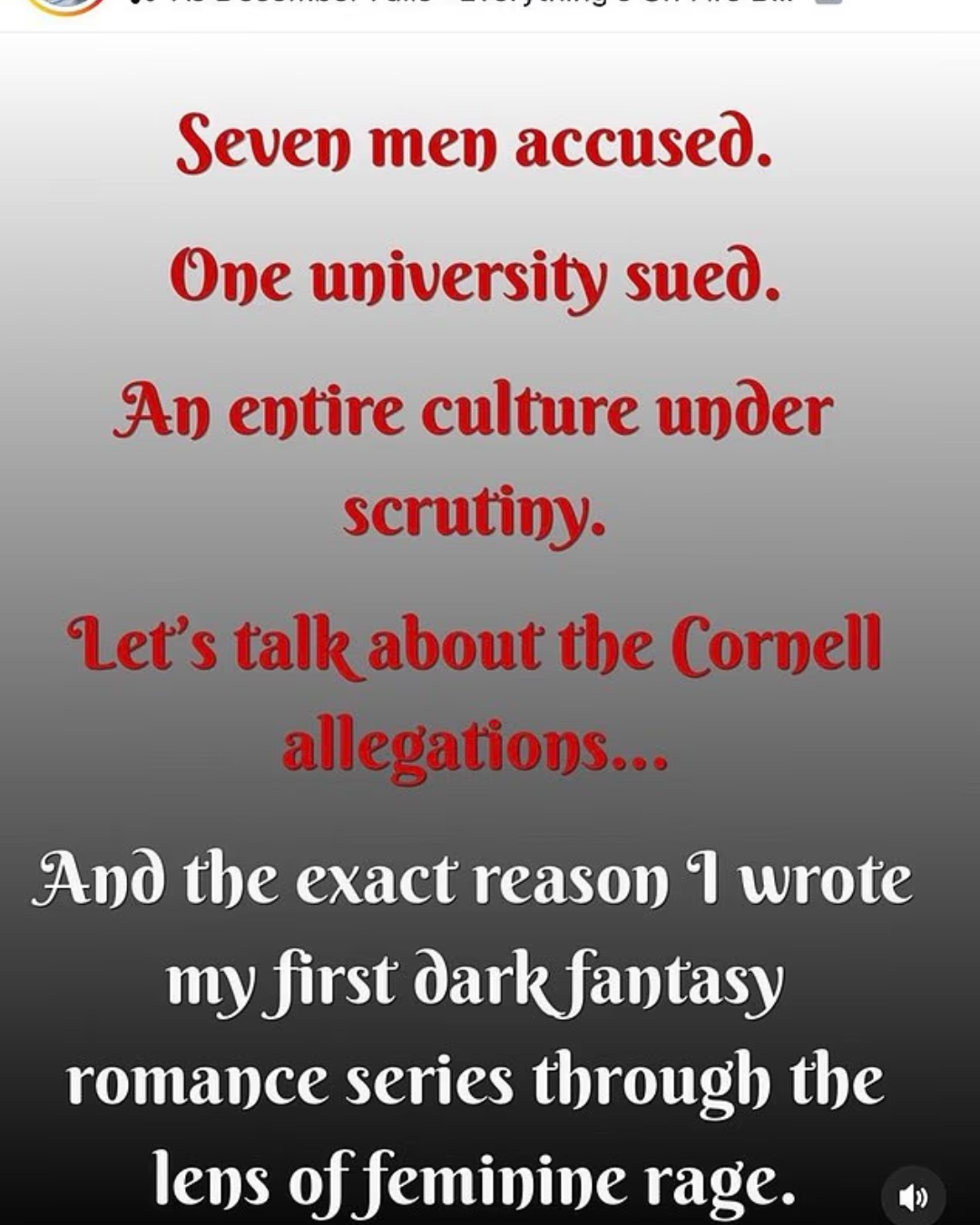
Credit: Instagram
But here’s where people got angry, because the author jarringly connected it to her book.
“This is the exact question inside my new dark fantasy romance series, Threads of Fate. What happens when men actively commit violence? What happens when others become complicit through obedience, loyalty or silence?” she went on. “What happens when supposedly honourable men serve a brutal system because defying it would cost them everything? And what happens when women stop asking the system to acknowledge their humanity and simply take it?”
She echoed similar sentiments in the final few slides, and it got so much backlash that she deleted the post.



She then issued a lengthy apology
View this post on Instagram
After the backlash, which included people calling her “horrible” for “exploiting” Jane Doe’s story, she posted another message to her Instagram.
It read: “I want to respond clearly to the concern that I used a survivor’s trauma to market my book, because that was absolutely not the intention and I apologise to those who believe that it was. My series was written long before the Cornell allegations became public. It’s themes were not inspired by this case, nor was the
post intended to suggest that they were.
“The series grew from anger I have carried for years about institutional power, violence against women and the people who enable that violence through loyalty, silence and inaction. That anger is what made me sit down and write in the first place. My intention in mentioning Threads of Fate was to explain why these questions already exist within my work and why this story affected me so deeply.
She pointed out there was no pre-order link, but that she “understands” the anger the post caused.
She added: “I absolutely pray that this woman gets the justice she deserves and that the spotlight brought to these issues in the media means asking the uncomfortable questions about those who not only perpetrate these acts but also standby and allow them to happen.
“The news simply exposed, once again, the very culture of complicity 1 bad already written about due to my own fury and experiences with these topics. I should have made that distinction much clearer in the original post and for that I apologise.”
Despite the apology, the post did little to defuse the anger her first statement generated. Some have argued that the issue was never the insinuation that the Cornell story inspired her book.
The issue, as one person put it, was the “centring” of herself in an unrelated story.
For more like this, like The Tab on Facebook.
Featured image credit:


Latest
Author responds to backlash after using Cornell case to ‘promote’ her steamy dark fantasy book

‘Seven men accused. One university sued. An entire culture under scrutiny’

The Love Island golden trio: How Molly- Mae, Maura Higgins and Olivia Attwood will never be knocked off

An investigation into their unprecedented success
Newly single OG Love Island lad is apparently set for All Stars return after secret ITV chat
He coupled up with seven different girlies on his first season
Photos show what Lizzie Borden’s maid Bridget looked like in real life after Netflix’s Monster

She settled in Montana after leaving the Bordens

Passengers speak out after pilot stabbed co-pilot mid-flight, dropping plane 17,000ft in minutes
Thankfully, other pilots were on the flight and were able to land the plane safely
From John Wayne Gacy to Aileen Wuornos, all the real killers linked in Netflix’s Monster

It has featured way more infamous killers

People fuming as Zoe Sugg and Alfie Deyes send brand promo emails during internet break
‘I feel like a cash grab’
Monster’s showrunner explains the frustrating reason he invented half of The Lizzie Borden Story
I didn’t realise historical facts are optional


How Cornell kept a 2024 sexual assault case out of the public eye for nearly two years
The full allegations have only just become public


University of Bath launches investigation after ‘terrified’ students raise concerns about Rugby Club

Rugby Club members allegedly aimed to spike female students as an ‘initiation’
Perez Hilton has been reunited with his kids, his family confirm in detailed 500-word update
There are aspects of his recovery that are still ‘hard’
Sarah Paulson calls out ‘weird’ criticism of her portrayal of Aileen Wuornos in The Lizzie Borden Story
She’s defended how she told the story

Great British Bake Off’s first eliminated baker Danni has spoken out since leaving the tent
They’re pretty happy with how it all went
Rita Ora sued by her former manager in £3million legal battle over missing tour and TV cash
‘It’s sad it has had to come to this’
‘No remorse’: Victim’s mother speaks out as Christa Pike set to be executed after 30 years
She is travelling to Tennessee to witness her execution
Reality TV star found guilty of murdering wife after his AI songs about affair played in court
The woman he had an affair with testified against him in court



How to spot a nightmare flatmate at UofG

Recognise the red flags early and save yourselves from hell