
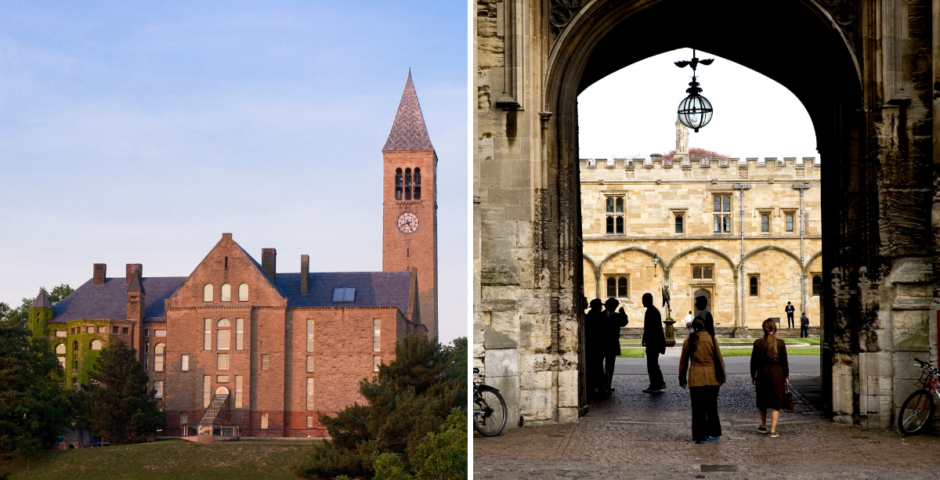
The Cornell case is horrific, but sexual violence on campus is not just an American issue
The allegations are a reminder that university sexual violence is everywhere
The criminal investigation into the alleged gang r*pe of a Cornell University student is being reopened nearly two years after she reported the incident. It is a deeply disturbing case, but it is also one that has been difficult to read without thinking about universities much closer to home.
*This article contains details that may be upsetting.*
Via Canva
In 2024, a 20-year-old Cornell student alleged that she had been drugged and sexually assaulted by seven men inside the Chi Phi fraternity house. She says she was given alcohol and ketamine before being sexually assaulted over several hours. She reported what happened and went through Cornell’s disciplinary process, but the case did not result in criminal charges at the time.
According to the woman’s attorney, two of the seven students accused were expelled, while the others received lesser sanctions. Cornell disputes claims that written assignments were given as the sole punishment for any of the accused, saying its disciplinary process resulted in expulsions and suspensions.
Now, nearly two years later, prosecutors in New York are reopening the criminal investigation. The Tompkins County District Attorney says the case will be presented to a grand jury, while prosecutors have said that allegations made in the woman’s civil lawsuit differ significantly from her original statement. Her attorney disputes that characterisation and has argued that the original investigation was inadequate.
Cornell has since barred the fraternity’s campus chapter, launched a sexual assault task force and said it supports the reopened investigation.
While everything about this particular case needs to be treated with the seriousness it deserves, I can’t help thinking about how easy it is to look at something like this and file it away as an American university horror story: It isn’t.
I know that because I was sexually assaulted in my first year of university, and over the years I’ve had countless friends tell me about their own experiences of sexual assault or harassment while at university. These aren’t stories that feel remote or unfamiliar. They are part of the reality of being a young person on a university campus, and that is precisely why the Cornell case feels like something we should be looking at much closer to home.
Via Canva
The numbers in the UK are not exactly reassuring. The Office for Students’ first sector-wide survey into sexual misconduct found that 24.5 per cent of final-year undergraduate students who responded had experienced sexual harassment since entering higher education. A further 14.1 per cent reported experiencing sexual assault or violence, including rape, attempted rape and unwanted touching.
More than 50,000 students responded to the survey, making it the largest prevalence survey of its kind in the UK. Women were significantly more likely than men to report experiencing sexual violence and harassment. Around 19 per cent of female respondents reported sexual assault or violence, compared with seven per cent of male respondents, while 33 per cent of women reported sexual harassment compared with 12.2 per cent of men.
Those figures are enormous, but perhaps what makes them so difficult to process is that they aren’t really about numbers. Every percentage point represents students who were supposed to be worrying about seminars, deadlines, societies, nights out and where they were going to live next year, and instead found themselves dealing with something that can fundamentally change how safe they feel in the world.



The Cornell case is far from the only disturbing story involving students and sexual violence currently making headlines in the UK. The University of Bath is investigating reports that members of its rugby team allegedly planned to spike female students as part of a Freshers’ initiation.
These stories are horrifying in their own right, but they also make the OfS figures harder to dismiss as distant statistics. They point to a much wider culture around sexual violence that exists both on university campuses and online, and one that students are having to navigate alongside their degrees.
I remember being a first-year student myself and having to make the decision to speak about what had happened to me. It is incredibly difficult to explain the weight of that decision unless you’ve had to make it. There is the incident itself, but then there is everything that comes afterwards: Wondering who will believe you, whether you should report it, what people will think, what happens if the person is still around you and whether saying something will actually change anything.
The OfS data shows just how many students choose not to formally report their experiences. Of those who said they had experienced sexual harassment in the previous year, only 13.2 per cent said they had made a formal report to their university or college. Among those who did report, 46.7 per cent described their experience as good, while 39.3 per cent described it as poor.
That should matter when we talk about cases like Cornell.
It is easy to focus on the most shocking details of one case, particularly when it is happening thousands of miles away. But the bigger issue is what happens when a student says something has happened to them, and whether they feel that there is a system capable of listening to them properly and taking their allegations seriously.
That doesn’t mean the Cornell case should be used to make assumptions about what happened, or that the UK and US systems can simply be compared like-for-like. They can’t. The legal processes, university disciplinary systems and circumstances are different, and the allegations in this case will ultimately have to be tested through the appropriate process.
The OfS’s interim chief executive Josh Fleming said in the survey: “Every student should be able to enter higher education with the knowledge that they will be safe from sexual harassment and assault. Sadly, we know that isn’t the case for a significant number of students across the country.”
That is the part that sticks with me.
University is sold to young people as a fresh start: Your first real taste of independence, new friends, nights out and a life that is finally your own. For so many students, it is all of those things. But for others, it can also be where they first experience sexual violence or harassment, and where they have to learn far earlier than they should how complicated it can be to speak about it. Cornell may be thousands of miles away; the issue isn’t.
For more like this, like The Tab on Facebook.
Featured image via Canva
Latest
The Cornell case is horrific, but sexual violence on campus is not just an American issue

The allegations are a reminder that university sexual violence is everywhere

Where the iconic Lizzie McGuire cast are now 25 years on, from Adam Lamberg to Hallie Todd

Hilary Duff just did five tour dates in the UK

New Cornell fraternity group chat messages have surfaced as the criminal case is reopened
The messages are from a Snapchat group
‘In an amazing place’: Inside wholesome life Ariana Grande is now enjoying away from the public

When she will be back has also been shared

Lizzie Borden’s neighbour who was first at murder scene spoke in court about what she saw
She was there before the doctor

Monster skipped the real Lizzie Borden’s attempt to buy poison the day before the murders
It became trial evidence

TikTok loves Jean Philanthrope, but ‘French Lord Farquaad’s’ backstory is disappointing

Need his hair care routine

Manchester farm shop introduces filming restrictions after Molly-Mae made it influencer hotspot

The Hollies Farm Shop is restricting visitors during certain hours

Real accounts of what Lizzie Borden’s maid Bridget Sullivan was like as a person
She kept herself to herself

Police release pic of 30 uni students crammed into hot basement covered in food as two arrested
Some had ‘visible injuries’


Chris Watts ends prison relationship and calls off his jail wedding just weeks after it went public
His ‘wife’ had already been wearing a wedding ring

Real-life photos of Lizzie Borden’s parents show what they looked like over the years
Andrew and Abby look too young in Monster

Madonna’s family reportedly concerned about her health as they urge her to ‘slow down’ after VMAs
She’s keen to get ‘straight back to work’

Still not convinced about joining us? Here’s what ex-writers say about The King’s Tab

‘The Tab gives you the space to be your most authentic self’

Lizzie Borden’s doctor’s full court testimony, where he recalled finding Andrew and Abby dead
‘His face was hardly to be recognised by one who knew him’

A weapon in the Lizzie Borden case was never found, and it might not have even been an axe
Many different theories were investigated

Lizzie Borden wasn’t right for Monster, and the ‘female rage’ reason they chose her makes it worse
There was so much wrong with it

The full Celebrity Traitors 2026 episode schedule as day change is confirmed
Don’t get caught out when it returns this week