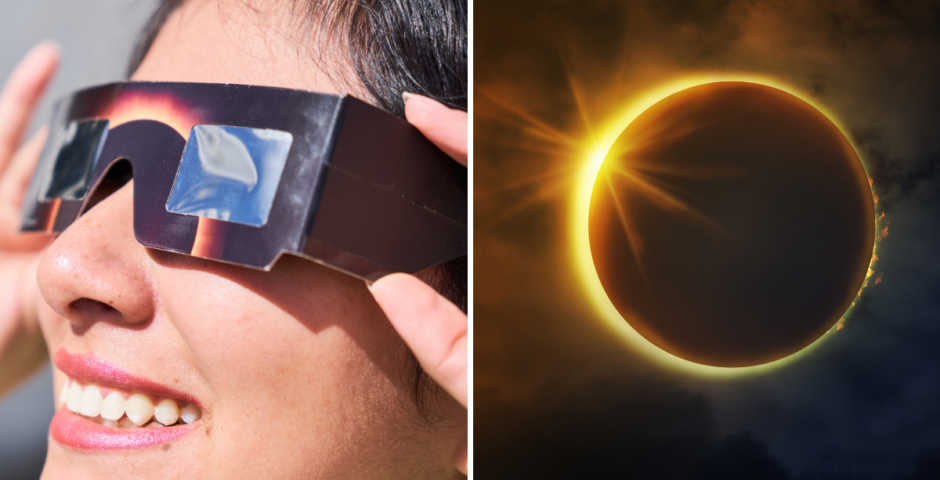
Here’s what actually happens to your eyes if you stare at a solar eclipse without glasses
You mean I can’t just wear my sunglasses?!
If you’re planning on watching the solar eclipse this evening, there is one very important thing you need to know before you start staring at the sky.
Via Canva
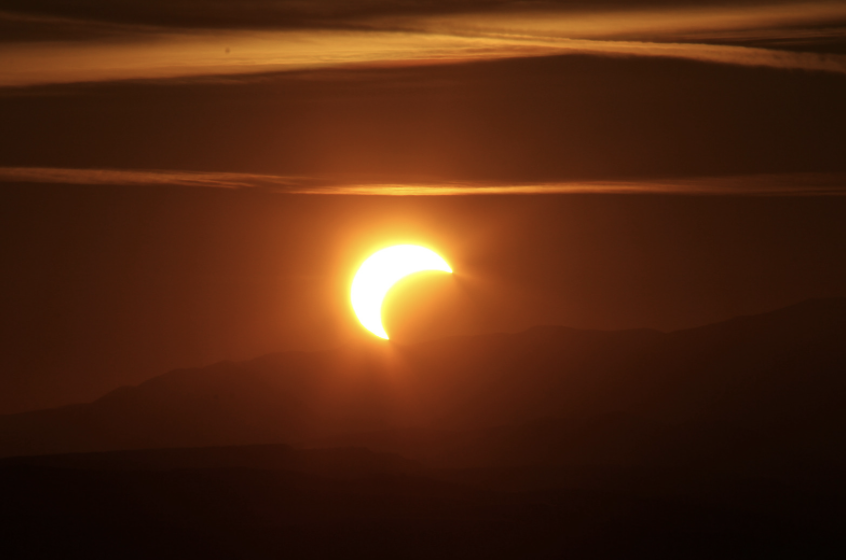
The UK is set to get a spectacular partial solar eclipse today, giving everyone the chance to see the moon move across the sun. It’s the sort of thing you’re obviously going to want to look at, but doing so without the right protection could leave you with permanent damage to your eyesight.
So, before you head outside to see it, here’s exactly how to watch the eclipse without putting your eyes at risk.
Don’t just grab your sunglasses
It might seem obvious to reach for a pair of sunglasses when you’re looking towards something as bright as the Sun, but they aren’t enough.
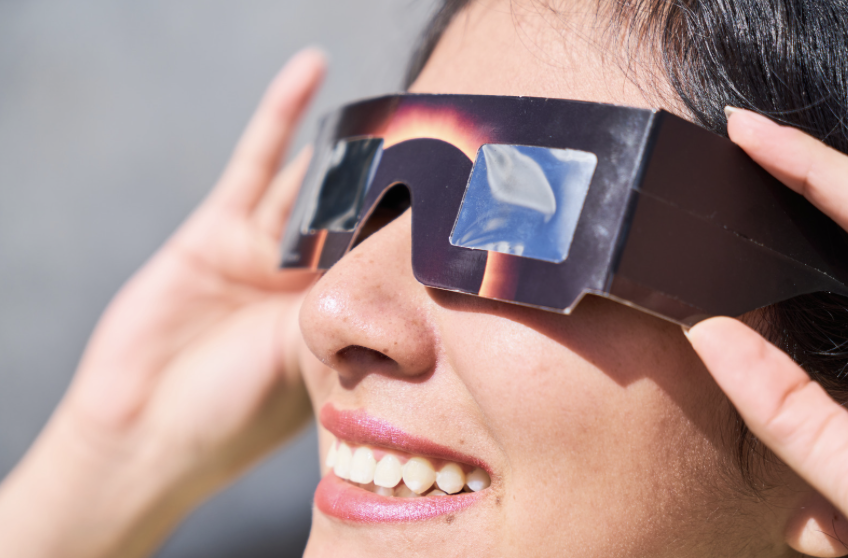
The advice is to use certified eclipse glasses that meet the international ISO 12312-2 safety standard. Normal sunglasses won’t protect your eyes from the radiation coming from the Sun, even if they’re particularly dark. And doubling up with two pairs won’t magically make them safe either.
Via Canva
If you’re planning to get a closer look using a camera, telescope or binoculars, you’ll also need approved solar filters attached to the equipment.
There is a way to watch the eclipse without special glasses, though. An indirect viewing method, such as a pinhole projector, allows you to see an image of the Sun projected onto a surface rather than looking straight at it.
The basic idea is to have the Sun behind you and watch the projected image instead.

So what if you do look?
This is where things get pretty scary.
NASA warns that looking at the Sun directly without specialist eye protection can cause severe eye injury. The same applies if you’re viewing it through a camera, binoculars or telescope without the correct solar filter fitted to the front.
One of the biggest problems is that you might not immediately know you’ve hurt yourself. Permanent damage caused by staring at the Sun is known as solar retinopathy. The retina doesn’t have pain receptors, meaning your eyes can be injured without giving you the usual warning signs that something is wrong.
Via Canva
And you don’t necessarily have to spend ages staring at the Sun for something to go wrong. Figures from the Royal College of Ophthalmologists recorded around 70 cases of vision problems after the 1999 solar eclipse. Around 40 per cent of those affected had watched the eclipse for less than a minute.
The UKHSA has also made it clear that sunglasses, as well as 3D glasses, aren’t a safe alternative to proper eclipse glasses or handheld solar viewers. They might make the Sun appear less dazzling, but they don’t filter out the harmful solar radiation that can reach your eyes.
The safest option is simple: Use proper eclipse protection and never stare directly at the Sun.
For more like this, like The Tab on Facebook.
Featured image credit via Canva
Read Next

Latest

London university releases statement after professor sentenced for a child sexual offence

Barry Langford was a Professor of Film Studies at Royal Holloway



Young father-of-two died on day he was due to start at University of Glasgow

Young father tragically passes away at 24 years old after suffering a brain aneurysm
Bella Ramsey’s specific acting career gives them ‘an edge’ on Celebrity Traitors (they hope)
Their past roles have prepped them for Missions
12 of The Celebrity Traitors season two cast asked to be Traitors, and six to be Faithfuls
Three celebs couldn’t make up their minds
Maya Jama’s game plan for Celebrity Traitors is to avoid trying ‘too hard’ or ‘overthinking’
This is really devious tbh
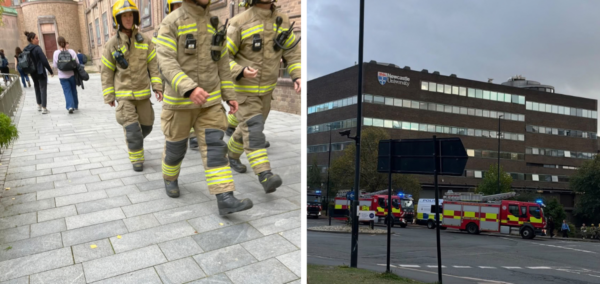
Newcastle University buildings evacuated after ‘suspicious item’ found on campus

Police, fire crews, and fire engines arrived at the scene
12 things every Fresher gets wrong in their first few weeks at uni

From wearing your lanyard everywhere to leaving your washing-up until it grows its own ecosystem

Our Celebrity Traitors predictions include Maya Jama turning on her fellow Traitors

Here’s what we think will happen

I’ve just realised that three cast members from Celebrity Traitors were in Game of Thrones

Having flashbacks to Bella Ramsey being crushed by a giant


23 to 70: The ages of the Celebrity Traitors 2026 cast, from youngest to oldest

There’s a huge age range this year

James Blunt was a British Army captain before becoming a singer and joining Celebrity Traitors
He mentioned it on the show

Monster director finally admits why they forced Aileen Wuornos in a show about Lizzie Borden
Despite the name, Lizzie Borden is not the focus of the story
Shows and films you can watch about Aileen Wuornos, where she isn’t thrown into another story

Others tell her entire case, unlike Monster on Netflix
This viral tool lets you customise your Apple Pay cards, and here’s how to do it
You can personalise the entire design

James Acaster could be the Celebrity Traitors’ recruit, as filming reportedly paused for him
It’s not much of a cliffhanger

The ridiculous fortunes of The Celebrity Traitors: Their net worths, from £500K to £50 million
One of them could legit buy the castle three times over
The Celebrity Traitors rules explained, as Richard E Grant immediately let slip he’s a Traitor
There’s actually a slightly confusing loophole