

We’ve hit a bleak wall. So are we about to see the end of ‘experimental’ dating shows?
A look into reality TV’s most toxic trope
When you think of the word “experiment” in a TV sense, your mind might be drawn to shows such as MAFS or Love Is Blind. Experts and hosts of these shows constantly refer to the “experiment” cast members are taking part in, and the quest to see if it can find you true love.
But there’s a dark underbelly to this. The word “experiment”, to me, has come to be a thin veil for meaning participants are being pushed to their limits, and placed into an intense environment, with often horrible outcomes.
It’s nothing new to say that cast members have raised their concerns, which is a bleak reality to be in. There have been lawsuits regarding the conditions for cast members on Love Is Blind, and MAFS UK was recently cancelled following an external review into participant welfare.
The production company behind Love Is Blind was forced to pay out over a million dollars as part of a class action lawsuit, with over 100 former cast and crew members lodging complaints. They said they were subjected to “inhumane working conditions”.
Brides on MAFS UK made sexual misconduct claims against the show. Two of the women claimed to have been raped while filming took place. MAFS UK was then culled, but should other shows follow suit?

via Netflix
Former producer for MAFS Australia, and host of the That’s Showbiz, Baby! podcast, Alex Funnell, worked on the show for two seasons. Her job would involve sitting and combing through upwards of 80 hours of a footage per week, to put the final episodes together. She said the show started out as an honest “experiment”, but now “it’s well and truly evolved past that” and cast members aren’t prepared.
“I think cast members can never prepare themselves for how strenuous and stressful and long the hours are,” she told me. “That’s what a lot of contestants come off the shows most perturbed by: ‘I didn’t expect it to be that full on’.” She said cast members are warned the show “could ruin their life” and are given examples of things that can come up. “A lot of people drop out,” she said.
Those who stick around don’t always get what they wanted, and in recent years we’ve seen more and more horror stories of problematic people slipping through the casting net. But, Alex thinks these shows offer – albeit a shocking one – a mirror to society. So, the answer isn’t removing the shows from TV, it’s fixing them.
When asked if cast members should be warned there is a chance they could be matched with someone problematic, Alex said: “No. That’s like saying if you’re getting on a bus, should you be warned there could be a predator on the bus? The presumption is that there’s not. You wouldn’t assume a human you’re interacting with is a predator.”
But, the problem needs to be addressed. She added it’s “not all men, but always men.” Alex said: “The predators are everywhere. We’ve got an issue with Married at First Sight because the men are f*cking up. We have an issue in the home because men are perpetrating violence. Yes, Married at First Sight has a responsibility, but it’s a broader issue, because at the crux of it, whether it’s on a TV show or in the streets, it’s a man problem. I don’t think it’s unique to Married at First Sight.
“Does the entertainment industry have a history of protecting powerful predatory men? Evidently, yes. It needs to be cleaned up. My general view would be that wherever there’s a problem, it’s always a male behavioural problem.
“I don’t know if full cancellation of every single show that has these experiences is the answer. I feel like it doesn’t need to be cancelled, it needs to be cleaned up. I don’t think the answer is just taking the shows away, because that’s a band-aid solution. The problem isn’t the show. The problem is the men. And they’re still going to be violent whether they’re on the show or not.”


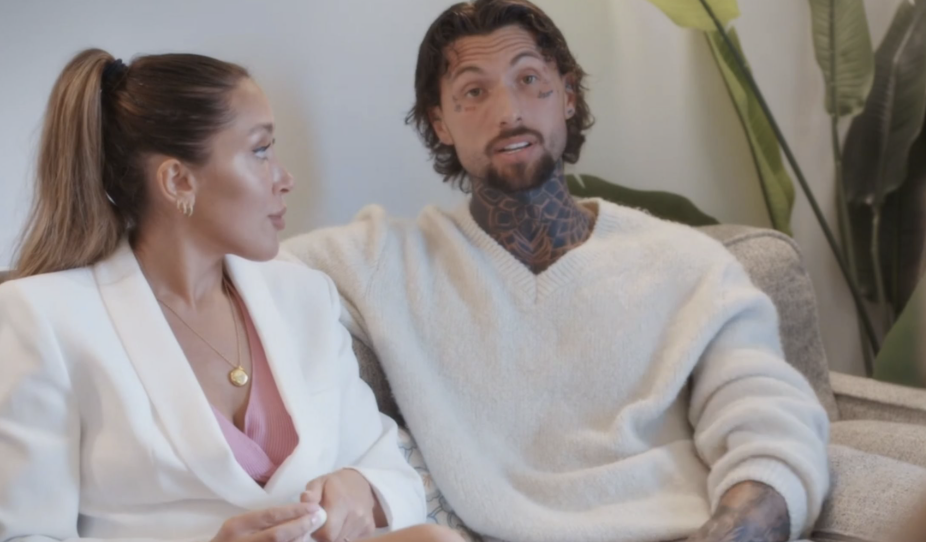
via Channel 4
To Alex, the shows are an important reflection of society, but those involved in making them need to learn how to deal with these situations better. “It’s about education. Educating the producers and the experts to know what to look out for,” she said. “Humans need to be educated.”
She added: “Maybe there needs to be more of a conversation around the nuance and the insidious, complicated nature of domestic violence, coercive control and sexual assault, and that needs to be fed into production as well. To be fair, the experts should know. But the producers are just people. They’re journalists, really. They’re just trying to get the story. They’re not thinking, ‘hang on, is this good or bad?’ They’ve got a deadline.
“So I think it needs to be embedded in a more holistic way: The importance of noticing signs of coercive control, and then it being called out and spoken about in a more complex, nuanced way. Maybe that’s expecting too much of a TV show, I don’t know. But to me it seems like an obvious workaround and a solution.”
During the investigation into MAFS UK, a former psychologist for the show admitted she didn’t think it ever should have aired. Dr Jo Hemmings told Channel 4 News: “My immediate reaction was that I don’t think the series should have been broadcast.” She questioned how claims from the women were able to “fall through the net”.
She said the show had a “very robust vetting procedure involved” and added that if anyone was not “resilient enough to go on the show” they would not have been allowed on it, but admitted, “you can’t be 100 per cent sure in terms of predictability, how someone is going to behave”.
Despite her initial concerns, Dr Jo Hemmings also had an idea of MAFS moving forward. “I think we’ve got to bring it back to something, which is, for want of a better word, it’s more wholesome,” she said.
“I don’t want it travelling down a road, particularly when it evolves intimate relationships, where conflict, controversy, combative behaviour, becomes the name of the game. This is not the way reality TV should go.”
At the end of the day, Alex believes MAFS UK will be back within the next couple of years, and the shows won’t end. “Production companies are not the conveyors of morality. They’re a business, in the most shrewd, unscrupulous business in the world,” she said.
“And I think that ‘the show must go on’ culture is probably still very much embedded in it. That’s probably the priority, realistically. They’ve got millions of dollars at stake.
“Cancelling the shows doesn’t stop domestic violence and sexual assault in society. It’s still going to be just as prevalent.”
For more like this, like The Tab on Facebook. Alex shares more insight into MAFS on her podcast, and on TikTok here.
Latest
A guide to curing homesickness in Sheffield
The Sheffield Tab’s guide to coping with homesickness during the cosy season
A breakdown of the intense 76-question questionnaire and application for Love Is Blind

All these questions and they still cast the worst people ever
Seven things you need to do before Chapter 3 ends in GTA 6, as they’ll be gone for good

There are so many missables

Oxford tops ranking of the Russell Group universities with the cleverest lecturers in 2026

Surprisingly, UCL has more prestigious academics than Cambridge

Dua Lipa to a 2015 hit: The songs that have climbed the charts after featuring in GTA 6
The GTA effect is real
From College Green to Westminster: growing pressure over Rosebank oilfield
Bristol Rosebank protestors’ demands gain urgency
Bake Off’s final three share emotional letters ahead of the final and people are very confused
Don’t worry, no one has been eliminated

Unlocking hairstyles, and four other handy things you can use the WAiNK app in GTA 6 for
This feature will get more makeup for Lucia
Celebrities call out Mariella Frostrup over her ‘aggressive’ comment about AJ Odudu on I’m A Celeb
Her mum has also spoken out

Five foolproof ways to lower your Criminal Profile in Grand Theft Auto VI
Start driving over gravestones now!

GTA VI’s hidden buttons and mechanics are game changers, but the tutorial never covered them

Turns out I’ve been playing the game wrong

Don’t let deadlines ruin your vibe: Here’s how to get into the festive spirit in Liverpool
Who said you can’t be festive and academically stressed out?
Bath University students book lecture hall to plan their ‘crisis’ second-year house hunt
Finding student housing is ‘extremely competitive’ and ‘difficult’

11 things you must do before finishing Chapter 2 in GTA 6, because you can’t go back
Most of them revolve around the Starlet Motel
Euphoria star to Rookie actress: The rogue hidden celebs we all missed in GTA VI
Oscar winner Jeremy Irons, what are you doing here?
Who the secret I’m A Celeb 2026 smokers and vapers are, and the rules about it in camp
We never see it on camera