

Cambridge Climate Justice holds teachout in support of strikes
Organised by Cambridge Climate Justice, here’s what lecturers, SU members, and activists had to say

Last Thursday (17/02), Cambridge Climate Justice organized a teach-out in support of the UCU strikes at Sidgwick Site. A teach-out is a communal teaching session organised to help picketers learn whilst they’re on the picket lines, aimed at mitigating the impact of lost teaching.
Speakers at this particular teach-out included Jason Scott-Warren (a lecturer and a climate activist), the Cambridge SU Undergraduate President and representatives of Youth Climate Swarm, Extinction Rebellion Cambridge, and the Justice 4 Workers Campaign.
The climate crisis
The first speaker was Alex, a representative of the Cambridge University Justice 4 Workers Campaign. They sought to establish links between the aims of Cambridge Climate Justice and the strikers, arguing that “workers need a livable planet.” They also asserted that “staff participation has been super important in getting through the divestment campaign even here at Cambridge.”
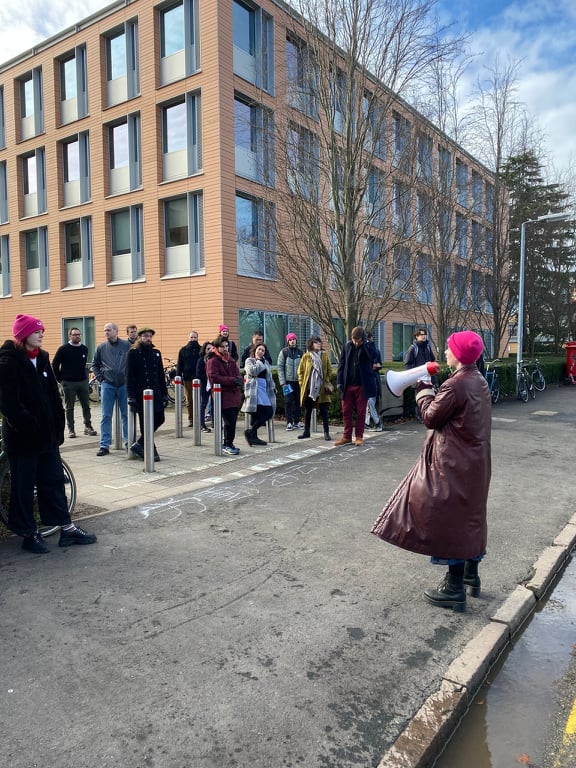
Image credits: Anjum Nahar
Another key speaker was the Cambridge SU President (UG), Zak Coleman. He drew attention to the University’s absolute zero emissions targets, highlighting that “the University has targets for 2048 – which shouldn’t be the target for the wealthiest university in Europe.”
Zak claimed, “We need urgently and desperately for the University to take a firm stance,” calling for absolute zero emissions targets to be revised to 2030.
🚨 Very excited to launch my Manifesto and Petition for a Fossil Free Cambridge University 💥✊🏻
📖 Full manifesto here 👉🏽https://t.co/jbHyQyawIM…
✍🏼 SIGN the petition here 👉🏽https://t.co/apqrMV6Iln…@CambridgeUni urgently needs to step up on climate.
Here's how 👇 pic.twitter.com/OromEC3gZS
— Cambridge SU (@SU_PresidentUG) February 18, 2022
Also in attendance was a representative of Youth Climate Swarm, an activist group that received attention from Cambridge students last week. A member of YCS recently interrupted Trinity College Cambridge’s lunch service by standing on a table and covering herself with fake oil (read more here).
Referring to capitalism, the YCS representative alleged that “the system that overworks and underpays its workers is the same system that exploits natural resources in the name of endless economic growth.” They also proclaimed that “many of us will not live to an old age, and many of us will see our children starve” and that there would be “mass civil resistance” in March.


Disruption and the strikes
Jason Scott-Warren, a lecturer at the Faculty of English, criticized the “exploitation lying at the heart of neoliberalism” and characterized capitalism as “a scorched earth policy” that destroyed “habitats and ecosystems and traditions.” Scott-Warren also described the climate emergency as “a product of colonialism.”
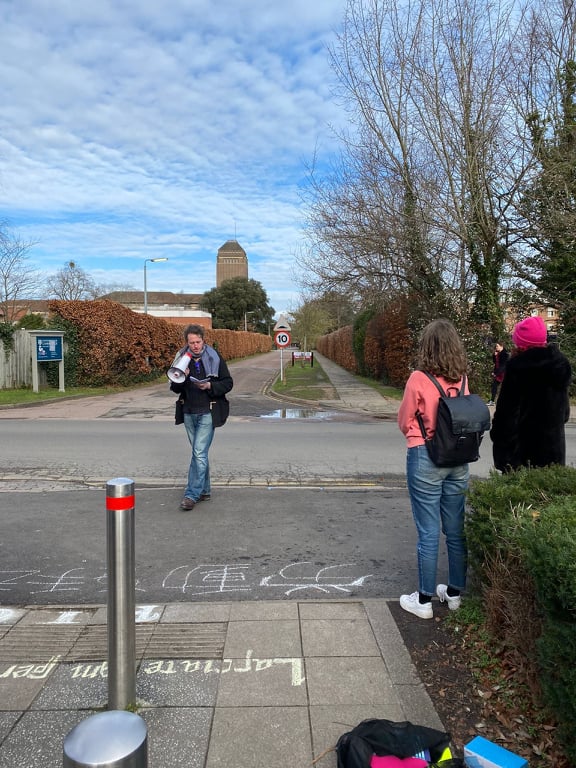
Image credits: Anjum Nahar
Addressing both strike action and climate activism, he also suggested that “disruption can be exactly what we need [in the future] as it is now.”
The lecturer further stated that “Cambridge is a very expensive place to live, especially for new and young academics” – particularly in light of falling real wages, which the UCU claims have fallen by nearly 20% since 2009.
When challenged with the fact that the UCU strikes worsened disruption to student teaching – which the Vice-Chancellor described as “particularly unfair” after “two extremely difficult years caused by the pandemic” – he claimed that lecturers had stood up for students during the pandemic by adjusting to new teaching methods, often while juggling work and childcare, “with little support from the University.”
A spokesperson for XR Cambridge, another activist group that attended the teach-out, claimed, “You need numbers. You need to hit them where it hurts so they’re forced to sit up and pay attention. You have to break the law. It has to stay non-violent. You have to fight until people sit up and take notice.” They also spoke in favour of disruption, alleging that “as costs go up each day with disruption, that is the way forward.”
Earlier this year, in January, XR Cambridge claimed responsibility for covering the Senate House in fake oil.
As of 22/02, there are three more days of industrial action organised by the UCU, to be held from 28 Feb to 2 March, during which further teach-outs are expected to take place.
The University of Cambridge Office of External Affairs and Communications was contacted for comment.
Feature image credits: Joey Bream
Latest

The Lizzie Borden Story cast next to the real people show how accurate Netflix’s Monster is

At least it got one thing right

Aileen Wuornos had a husband and a child in further backstory Netflix’s Monster didn’t mention

Her husband was 49 years her senior

Emma Borden’s confused argument with a lawyer at Lizzie’s trial was very different in real life

She suddenly forgot what she’d earlier said

Footage of real Aileen Wuornos next to Monster on Netflix shows just how accurate scenes were
Monster gets a lot wrong, but Sarah Paulson gets everything right

Lizzie Borden’s sister gave a single interview 20 years later, saying the house was ‘unbearable’
‘As for her being guilty, I say no, and decidedly, no’
Aileen Wuornos’ tragic childhood explained, from her absent parents to life on the streets

Her past is explored in Monster
The healing power of housemates in eating disorder recovery

Friendships at university have more healing powers than initially perceived
40 years later, one of the Unsolved Mysteries cold cases has just been solved
Police thought they’d never have answers

Hudson Williams’ girlfriend condemns people going to her workplace and crossing ‘huge’ boundary
‘I didn’t ever want to have to say anything about this’
Family not informed of missing Lancaster student because ‘it was a weekend’, inquest told

The dad of Henry Shields called it ‘shocking’ the family was not contacted despite his son missing ‘three exams’
Calling all students and incoming freshers: Apply now for The Cambridge Tab’s editorial team

Applications close at 11.59pm on Monday 12th October

The real history behind Lizzie Borden’s pet doves, as shown in Netflix’s Monster
The storyline is loosely based on fact

If you’ve never burped in your life, there’s actually a medical name for it
It’s a recognised condition
We want you! The Birmingham Tab is looking for new writers and content creators

Join us on Tuesday 6th October at 5pm for our open meeting in Joe’s Bar
The best three UK universities to study every subject at in 2027, as revealed by The Times

Imperial College London ranks first for medicine, not Cambridge or Oxford

Rotten Tomatoes alternative scoring movies on ‘woke’ themes divides people after going viral
Monster: The Lizzie Borden Story is 85 per cent ‘woke’
Meet Mae, the Great North Run runner who raised more than £2,000 for cancer research

Mae Craven completed the run in memory of her mum who died from cancer when she was 15

Four cast members in The Lizzie Borden Story have appeared in Monster seasons before
It’s not just Charlie Hunnam who came back

Five Russell Group uni cities make the top 10 for part-time student jobs, but Hull comes first
Students face an average £502 monthly gap between their maintenance loan and living costs, with 65 per cent of undergraduates now working during term time